

Your Business Has Followers. But Are They Becoming Customers?
You post consistently.
You create graphics.
You share offers.
You publish videos.
People like your content.
Some comment.
A few share it.
Your follower count slowly grows.
Then you look at your sales.
Nothing seems to move at the same speed.
That is where many businesses start asking the wrong question:
“How do we get more followers?”
The better question is:
“How do we turn social media attention into business?”
Because followers are not the final goal.
Likes are not the final goal.
Reach is not the final goal.
For most businesses, social media needs to contribute to something more meaningful:
Attention → Trust → Interest → Action → Customer → Growth
That is where strategic social media marketing becomes much more valuable than simply posting content.
Social Media Is Not Just a Place to Post
Think about how people discover businesses today.
They may:
- Search Google
- See your Instagram content
- Watch your video
- Discover your LinkedIn post
- See a Facebook advertisement
- Read comments from existing customers
- Visit your website
- Compare you with competitors
- Come back later before making a decision
Social media can influence several parts of that journey.
That means your social presence should not exist separately from your business.
It should support the bigger picture.
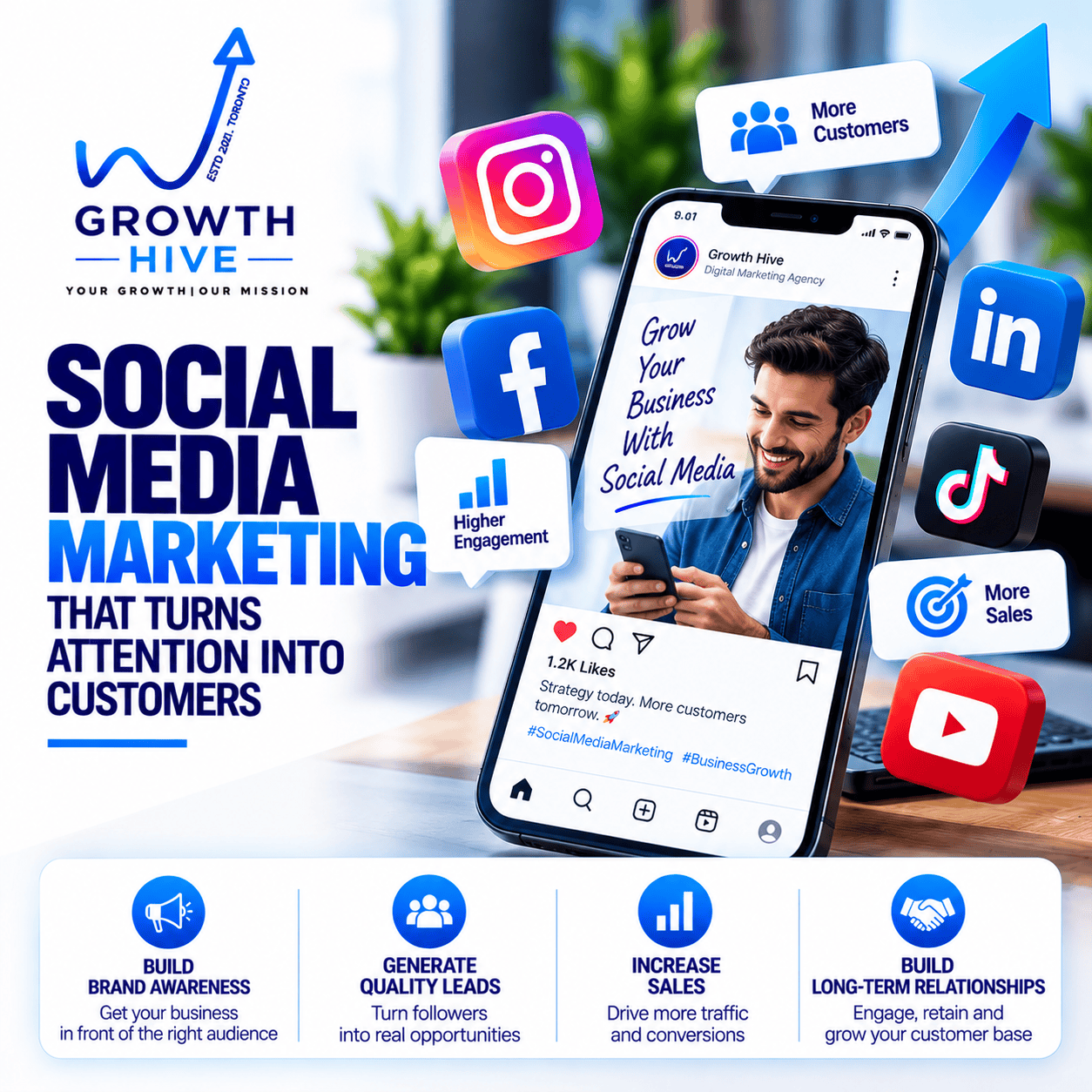
Growth Hive’s positioning reflects this broader approach: social media marketing is intended to build a stronger brand presence, engage audiences, and turn social platforms into growth channels rather than treating social activity as an isolated task. Pasted markdown
The Real Problem: Being Active Without Being Strategic
Many businesses are active on social media.
But activity and strategy are not the same thing.
A business can post five times a week and still have no clear answer to:
Who are we trying to reach?
What do we want them to do?
Why should they care?
What makes our business different?
Which content actually contributes to sales?
Where do interested people go after seeing our content?
Without those answers, social media can become a never-ending content treadmill.
Create post.
Publish.
Get likes.
Repeat.
And eventually someone asks:
“So… what did all this actually do for the business?”
That’s the point where your social media strategy needs to change.
Stop Creating Content Just to Fill the Calendar
A content calendar can tell you when to post.
It doesn’t necessarily tell you why you’re posting.
Every piece of content should have a job.
For example:
Educational Content
Helps people understand a problem and positions your business as knowledgeable.
Problem-Solution Content
Shows customers that your business understands what they’re struggling with.
Product or Service Content
Explains what you actually offer and why it matters.
Proof Content
Builds confidence through testimonials, case studies, results, demonstrations, or customer experiences.
Engagement Content
Creates conversations and helps your audience interact with the brand.
Promotional Content
Gives people a reason to take action.
A healthy social media strategy usually needs a mixture rather than turning every post into:
“Buy from us today!”
People don’t want to feel like they’re being advertised to every time they open an app.
They want something useful, interesting, relatable, entertaining, or relevant.
Your job is to connect that attention back to your business.
What Does Social Media Marketing Actually Do for a Business?
Let’s move beyond likes and followers.
A well-planned social media strategy can support several business objectives.
Build Brand Awareness
People cannot consider your business if they don’t know you exist.
Consistent, relevant content can help your brand become familiar to the audience you want to reach.
Build Trust
Before contacting a company, people often want reassurance.
They may look at:
- Your content
- Your website
- Your reviews
- Your expertise
- Your communication
- Your products
- Your previous work
Your social presence can help answer an important question:
“Can I trust this business?”
Generate Demand
Not everyone is actively searching for your service today.
Some people are aware of a problem but haven’t started looking for a solution.
Others don’t fully understand what they need yet.
Social content can introduce the problem, educate the audience, and create interest before someone becomes ready to buy.
Generate Leads
With the right offer and customer journey, social media can encourage people to:
- Send a message
- Request information
- Book a consultation
- Fill out a form
- Visit a website
- Request a quote
- Register for an event
- Start a trial
Support Sales
Social media can also help people make the final decision.
Product demonstrations, comparisons, FAQs, customer stories, reviews, and educational content can remove uncertainty.
Social Media Marketing Looks Different for Every Business
This is where generic social media strategies start to fall apart.
A restaurant doesn’t need the same strategy as a software company.
A real estate consultant doesn’t need the same content as an e-commerce brand.
A law firm doesn’t communicate like a fashion brand.
A local plumber doesn’t need to behave like a global technology company.
The platform, content style, posting frequency, advertising approach, and conversion journey should reflect the business.
Let’s look at some examples.
For Local & Service-Based Businesses
Imagine you run:
- A dental clinic
- A salon
- A restaurant
- A construction company
- A plumbing business
- A fitness center
- A cleaning service
- An auto repair shop
- A property consultant
- A home renovation company
Your audience usually wants to know:
Can you solve my problem?
And often:
Can I trust you?
Your content could demonstrate:
- Services
- Before-and-after transformations
- FAQs
- Customer experiences
- Team expertise
- Behind-the-scenes work
- Common mistakes
- Local knowledge
- Offers
- Demonstrations
- Educational tips
The objective isn’t to make every post viral.
It is to make the right potential customer think:
“These people understand what I need.”
For E-Commerce Businesses
E-commerce social media has a different challenge.
You need to make products interesting enough to stop someone scrolling.
Then you need to give them enough information and confidence to consider purchasing.
That could involve:
Product demonstrations → Benefits → Social proof → Objection handling → Offer → Purchase
Instead of simply posting:
“Our new product is available. Buy now!”
you can show:
What problem does it solve?
How does it work?
Who is it for?
What makes it different?
How does it look in real life?
What are customers saying?
Social media becomes part of the product discovery and buying journey.
For B2B Businesses
B2B social media often suffers from one major problem:
Everything sounds like a brochure.
“Leading solutions for modern businesses.”
“Innovative technology for your organization.”
“Transform your business today.”
It sounds professional.
But it doesn’t necessarily sound human.
B2B buyers are still people.
They have problems.
They have deadlines.
They have budgets.
They have internal objections.
They have bosses to convince.
They want answers.
A better B2B content strategy can discuss:
- Industry problems
- Customer questions
- Practical solutions
- Expert insights
- Case studies
- Common mistakes
- Market developments
- Product demonstrations
- Business outcomes
- Behind-the-scenes expertise
Instead of constantly saying:
“We are the best.”
Show people why your expertise matters.
For Professional Services
Lawyers.
Accountants.
Consultants.
Architects.
Engineers.
Healthcare providers.
Financial professionals.
Marketing agencies.
These businesses often sell something intangible:
Expertise.
That makes educational content particularly valuable.
You can answer questions people are already asking.
Explain complicated subjects simply.
Address common misconceptions.
Show your methodology.
Discuss real-world problems.
Share useful insights.
The objective is to reduce uncertainty.
When someone eventually needs the service, your business is no longer completely unfamiliar.
You’ve already demonstrated knowledge.
For Startups
Startups have another challenge:
Nobody knows you yet.
You may have a great product.
But the market doesn’t automatically understand:
- Who you are
- What you solve
- Why the problem matters
- Why your solution is different
- Who should buy it
Social media can help startups tell that story.
Instead of trying to appear like a massive corporation, show the journey.
Talk about the problem.
Show the product.
Explain the thinking.
Share customer experiences.
Answer questions.
Demonstrate the product.
Build a community around the problem you are solving.
People can connect with a business story long before they become customers.
Your Audience Doesn’t Want Another Advertisement
This is one of the most important lessons in social media marketing.
Imagine scrolling through your feed.
Post.
BUY NOW.
Next.
LIMITED OFFER.
Next.
CONTACT US TODAY.
Next.
BEST QUALITY PRODUCTS.
Next.
DON’T MISS OUT.
Eventually, you stop paying attention.
Now imagine your feed contains:
“Three reasons your website visitors aren’t becoming customers.”
Then:
“Here’s what most businesses get wrong about Google Ads.”
Then:
“Before hiring a marketing agency, ask these five questions.”
Then:
“Here’s how we helped a business identify where its leads were being lost.”
Now you have a reason to keep reading.
That is the difference between promotional content and valuable content.
Your Content Should Start Conversations
Social media is called social for a reason.
If your entire strategy consists of publishing messages and disappearing, you’re missing part of the opportunity.
Pay attention to:
- Comments
- Questions
- Direct messages
- Mentions
- Reviews
- Complaints
- Customer feedback
- Common objections
These interactions contain valuable information.
A question appearing repeatedly in your comments could become a future post.
A common objection could become a video.
A customer complaint could reveal a process that needs improvement.
A frequently requested product could reveal demand.
Your audience is not just an audience.
It can also be a source of market intelligence.
Your Social Media Content Should Have a Destination
Here’s a question every business should ask:
“What happens if someone wants to learn more?”
If your post generates interest, where does the person go?
Maybe:
Social Post → Website
Or:
Video → Product Page
Or:
Educational Post → Consultation
Or:
Ad → Landing Page → Lead Form
Or:
Instagram → WhatsApp → Sales Conversation
Without a clear next step, your content can create attention without capturing the opportunity.
That’s why social media should connect with the rest of your digital ecosystem.
Growth Hive’s broader service model combines social media with SEO, PPC, content, web design, conversion optimization, web development, and local/business marketing rather than treating each activity as completely disconnected. Pasted markdown
Engagement Is Useful. But It Needs Context.
Let’s talk about likes.
Getting 5,000 likes feels great.
But what if none of those people are potential customers?
Meanwhile, another post gets 150 likes but generates 12 genuine inquiries.
Which one deserves more attention?
The answer depends on your business objectives.
That is why social media performance should be evaluated against meaningful outcomes, not vanity metrics alone.
Depending on your business, you may care about:
- Qualified inquiries
- Website traffic
- Product purchases
- Consultation bookings
- Leads
- Messages
- Sign-ups
- Audience growth
- Brand awareness
- Engagement quality
- Customer acquisition
The metric should support the objective.
Paid Social Media Can Expand the Reach
Organic content can build your presence.
Paid social can help put your message in front of specific audiences at scale.
This can be particularly useful when you have:
- A strong offer
- A defined target audience
- A conversion-focused landing page
- Useful creative
- A measurable objective
Paid social campaigns can be used for objectives such as:
Awareness
Introduce your business to relevant audiences.
Traffic
Send people to useful pages or content.
Leads
Encourage potential customers to submit their information.
Sales
Promote products or offers.
Remarketing
Reconnect with people who have already interacted with your business.
But paid advertising doesn’t fix weak fundamentals.
If the offer is unclear, the landing page is poor, or the audience is wrong, spending more money doesn’t automatically solve the problem.
Remarketing: The Customer Who Didn’t Buy Yet
Not everyone buys the first time they discover your business.
Someone may:
- Visit your website
- Look at a product
- Watch your video
- Read your content
- Add something to their cart
- Start a form
- Leave
That doesn’t necessarily mean they aren’t interested.
They may simply need more time.
Remarketing can help businesses reconnect with previous visitors or engaged audiences, depending on the platform, available data, privacy requirements, and campaign setup.
The message should also evolve.
Someone seeing your brand for the first time may need education.
Someone who already visited your pricing page may need reassurance.
Someone who abandoned a purchase may need a reminder or additional incentive.
Different stages require different messages.
The Content-to-Customer Journey
A strong social media strategy can be visualized like this:
01 — STOP
Create something that earns attention.
02 — INTEREST
Give people a reason to continue.
03 — VALUE
Teach, entertain, demonstrate, or solve something.
04 — TRUST
Show expertise, proof, transparency, and credibility.
05 — ACTION
Give the person a logical next step.
06 — CONVERSION
Turn the interested person into a lead, buyer, subscriber, or customer.
07 — RETENTION
Continue communicating after the first transaction.
This is much more powerful than thinking:
“We need three posts this week.”
What If Your Content Isn’t Getting Engagement?
Don’t immediately conclude:
“Social media doesn’t work for our business.”
First ask better questions.
Is the content relevant?
Are you talking about what your audience actually cares about?
Is the opening strong?
Would someone stop scrolling for this?
Is the message understandable?
Can someone understand the point quickly?
Is the format appropriate?
Could this idea work better as a short video, carousel, image, article, or story?
Are you talking to the right audience?
A highly engaging post shown to the wrong people may still have limited business value.
Are you consistent enough to learn?
One weak post doesn’t tell you whether the strategy is wrong.
You need patterns.
What If People Engage But Don’t Buy?
This is a different problem.
Your content may be doing its job at the awareness level.
But the conversion journey may be weak.
Look at what happens after engagement.
Is your offer clear?
Is there a relevant landing page?
Is the CTA obvious?
Can people easily contact you?
Does your website build trust?
Is the purchase process simple?
Are you following up with leads?
Social media cannot carry the entire customer journey by itself.
Sometimes the problem isn’t your content.
It’s what happens after the content.
What If Your Followers Keep Growing but Sales Don’t?
This is one of the most frustrating situations.
Your audience is growing.
Your reach is increasing.
Your engagement looks healthy.
But revenue isn’t moving.
It may mean that your social strategy is optimized for attention rather than commercial intent.
Look at your audience.
Are they potential customers?
Look at your content.
Does it address purchase-related problems?
Look at your CTA.
Does it provide a clear next step?
Look at your customer journey.
Can an interested follower easily become a lead or buyer?
The objective isn’t to turn every follower into a customer.
The objective is to create a system where the right people have a clear path toward becoming customers.
A Better Social Media Strategy Starts With Your Business
Before creating another post, answer these questions:
Who are we trying to reach?
Not “everyone.”
Define the people most relevant to your business.
What problem do they have?
What makes them search for a solution?
Why should they care?
What value do you provide?
Why should they trust us?
What evidence can you demonstrate?
What makes us different?
Why should they consider your business?
What action should they take?
Follow?
Visit?
Message?
Book?
Buy?
Subscribe?
How will we measure success?
Choose metrics connected to your business objective.
This turns social media from a content activity into a marketing system.
A Practical Social Media Framework for Any Business
Here’s a simple framework you can adapt.
ATTRACT
Create content that gets the attention of your ideal audience.
EDUCATE
Help them understand their problem and possible solutions.
CONNECT
Make the brand feel human and approachable.
PROVE
Demonstrate expertise, results, customer experiences, or product value.
CONVERT
Provide a clear next step.
RETAIN
Continue building the relationship after the first interaction.
That last step is often forgotten.
A customer shouldn’t disappear from your social strategy immediately after purchasing.
Customers can become:
Repeat buyers.
Referrers.
Advocates.
Long-term clients.
Your relationship with the customer doesn’t necessarily end at conversion.
Stop Asking, “What Should We Post Today?”
Start asking:
“What does our audience need from us today?”
Maybe they need an answer.
Maybe they need education.
Maybe they need proof.
Maybe they need inspiration.
Maybe they need to see your product in action.
Maybe they need reassurance before buying.
Maybe they simply need to discover that your business exists.
That shift sounds small.
But it changes everything.
You stop creating content because the calendar says it’s Tuesday.
You start creating content because it serves a business and customer purpose.
Social Media Marketing Is a Long-Term Business Asset
A strong social media presence doesn’t happen overnight.
It takes:
Consistency.
Testing.
Creativity.
Audience understanding.
Community management.
Performance analysis.
Strategic refinement.
And most importantly:
A connection between marketing activity and business objectives.
Growth Hive’s approach emphasizes customized, ROI-driven digital strategies, transparent reporting, and scalable solutions rather than one-size-fits-all marketing. Pasted markdown
That philosophy matters because every business has a different starting point.
A local business may need visibility.
An e-commerce brand may need sales.
A B2B company may need qualified leads.
A startup may need awareness and market education.
An established company may need stronger customer engagement and acquisition.
The strategy should reflect the destination.
Your Social Media Should Work With Your Other Marketing
Social media doesn’t have to operate alone.
Think about the possibilities:
Social Media + SEO
Social content can help distribute useful ideas while SEO works to capture search demand.
Social Media + Google Ads
Paid social can create awareness and remarketing opportunities while search advertising captures active intent.
Social Media + Content Marketing
Long-form content can become short videos, carousels, posts, and educational content.
Social Media + Website
Your social presence can send interested people toward conversion-focused pages.
Social Media + Email
Social can help attract subscribers while email helps nurture relationships.
Social Media + Local Marketing
Local businesses can combine social visibility with local search and customer engagement.
The goal is not to have seven disconnected marketing activities.
The goal is to build a connected customer journey.
The Bottom Line
Social media marketing is not about posting more.
It is not about chasing every trend.
It is not about collecting followers just to make a number look impressive.
And it certainly isn’t about creating content without knowing what happens next.
Effective social media marketing connects attention with action.
It helps your business:
Get discovered.
Build trust.
Start conversations.
Educate potential customers.
Generate demand.
Capture opportunities.
Convert the right audience.
Build long-term relationships.
That’s the difference between having social media accounts and having a social media marketing strategy.
Ready to Turn Social Media Into a Growth Channel?
At Growth Hive, we believe your marketing should work for your business—not simply keep your business busy.
Our social media marketing approach is designed around your audience, market, business objectives, content needs, and growth opportunities.
Whether you’re a local service business, e-commerce brand, real estate company, healthcare provider, professional service, B2B company, startup, or established business, the strategy starts with understanding what you actually need to achieve.
We combine strategy, content, audience engagement, paid social opportunities, performance analysis, and the wider digital marketing ecosystem to help turn social media from an ongoing expense into a meaningful growth channel. Growth_Hive_Business_Brochure
Because the goal isn’t simply:
More posts.
Or:
More followers.
Or even:
More engagement.
The bigger goal is:
More visibility → More trust → More opportunities → More customers → More growth.
That’s what social media should be working toward.


Leave a Reply