

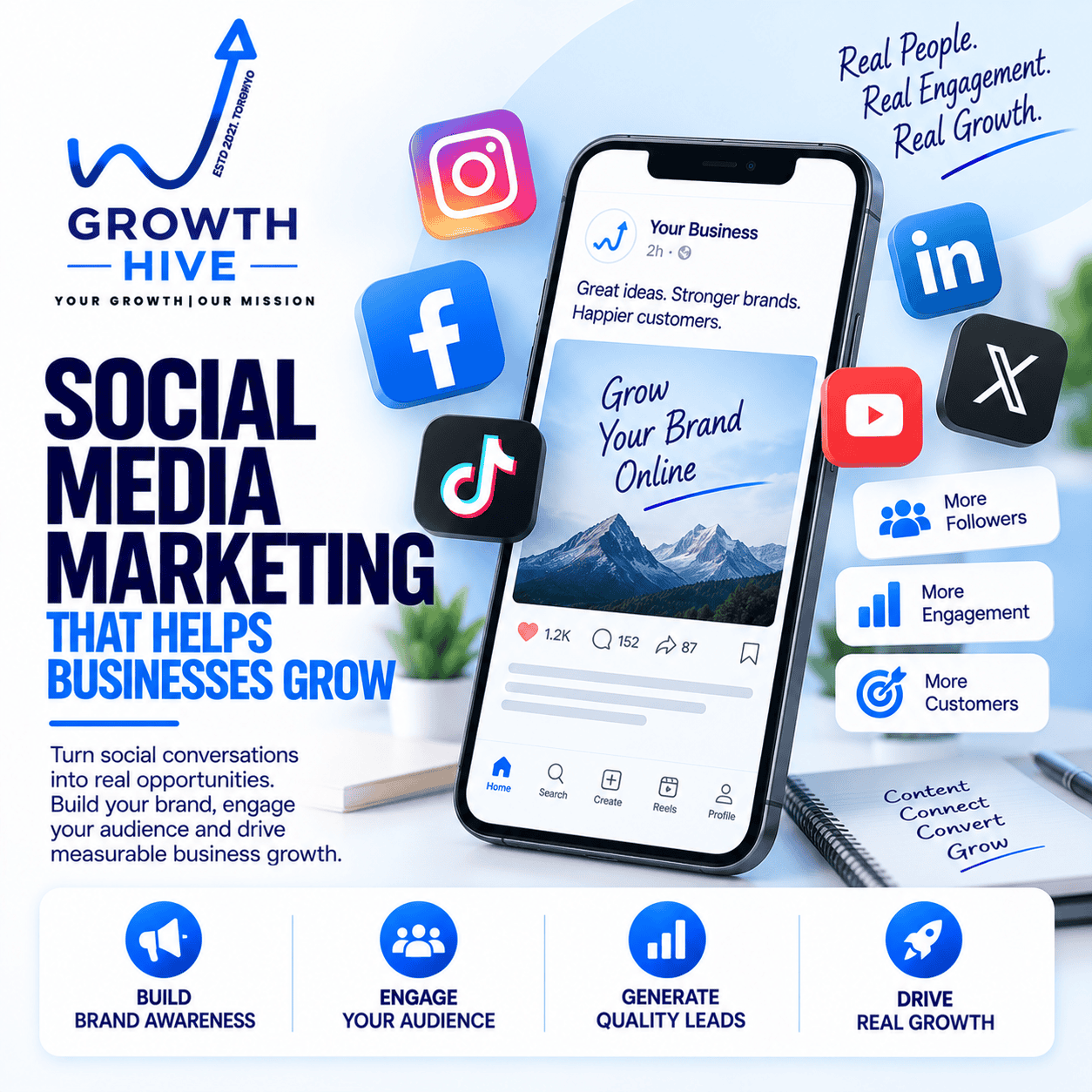
Social Media Is Not Just About Posting
Your business has a Facebook page.
You may have an Instagram account.
Perhaps you’re also active on LinkedIn, TikTok, or other platforms.
You post regularly.
You get some likes.
A few people comment.
But then you look at your sales.
Where are the customers?
This is where many businesses become frustrated with social media marketing.
The problem isn’t necessarily that social media isn’t working.
The problem may be that your social media activity isn’t connected to a business objective.
A business doesn’t need social media simply to look active.
It needs social media to help:
- Build awareness
- Reach the right audience
- Generate enquiries
- Promote products
- Build trust
- Drive website traffic
- Generate sales
- Retain customers
- Create a community
- Strengthen the brand
And those objectives require more than publishing random posts every day.
Social media marketing should give people a reason to notice your business, trust it, and eventually take action.
What Is Social Media Marketing?
Social media marketing is the strategic use of social platforms to communicate with audiences, build brand visibility, distribute content, engage customers and support business objectives.
Depending on your business, it can include:
- Social media strategy
- Content planning
- Creative development
- Copywriting
- Organic social media management
- Paid social advertising
- Audience targeting
- Community management
- Lead generation
- Product promotion
- Retargeting
- Social media analytics
- Competitor research
- Campaign optimization
The important word is strategy.
Posting every day isn’t automatically marketing.
There needs to be a reason behind what you’re publishing.
The Problems Businesses Actually Face on Social Media
Most businesses don’t need another generic social media checklist.
They need answers to real problems.
For example:
“We’re getting likes but no customers.”
“Our competitors are getting more attention.”
“We don’t know what to post.”
“Our audience isn’t engaging.”
“Our ads are spending money but not generating quality leads.”
“Our social media looks inconsistent.”
“We have followers, but they’re not buying.”
These problems require different solutions.
Let’s look at how social media marketing can address them.
Problem 1: “We Get Engagement, But No Sales”
Likes feel good.
Comments feel good.
Shares feel even better.
But none of them automatically pay your business expenses.
A post can receive thousands of impressions and generate zero meaningful business.
That’s why businesses should distinguish between:
Attention
and
Business results.
Your social strategy should connect content with actions such as:
- Website visits
- Enquiries
- Product views
- Leads
- Bookings
- Purchases
- Sign-ups
- Calls
The goal isn’t to eliminate engagement.
Engagement is valuable.
But it shouldn’t be the final destination.
Attention needs somewhere to go.
Problem 2: “We Don’t Know What to Post”
This is extremely common.
Monday arrives.
Someone asks:
“What are we posting today?”
Then the team creates another:
“Happy Monday!”
post.
Next week, it’s another generic quote.
Eventually, social media becomes a content-filling exercise.
A better approach starts with your customer’s questions.
What are they struggling with?
What mistakes are they making?
What do they want to know?
What prevents them from buying?
What misconceptions do they have?
What makes them hesitate?
What results do they want?
These questions can become content.
Build Content Around the Customer Journey
A strong social media strategy shouldn’t make every post sell something.
Instead, content can support different stages.
Awareness Content
Help people discover your business.
Examples:
- Industry insights
- Common problems
- Educational posts
- Short videos
- Trends
Consideration Content
Help people understand your solution.
Examples:
- How-to content
- Comparisons
- Product demonstrations
- FAQs
- Behind-the-scenes expertise
Trust Content
Give people reasons to believe you.
Examples:
- Testimonials
- Case studies
- Customer stories
- Results
- Team expertise
Conversion Content
Give people a reason to act.
Examples:
- Offers
- Product launches
- Consultation invitations
- Booking opportunities
- Lead-generation campaigns
This creates a much healthier content mix.
Problem 3: Your Competitors Are Getting More Attention
You see your competitor’s post.
Hundreds of comments.
Thousands of views.
People are talking about their brand.
Meanwhile, your account feels quiet.
Instead of simply copying what they’re doing, investigate why their content is resonating.
Look at:
- Topics
- Formats
- Messaging
- Offers
- Audience
- Posting patterns
- Visual presentation
- Engagement
- Customer questions
Then ask:
What can our business say that competitors cannot?
Your competitive advantage might be:
- Experience
- Product quality
- Speed
- Price
- Service
- Expertise
- Convenience
- Location
- Technology
- Customer experience
Social media should help communicate that difference.
Problem 4: Your Brand Doesn’t Look Consistent
One post uses blue.
The next uses red.
One graphic has five fonts.
Another has three.
The tone changes every week.
A customer sees your Instagram and then visits your website.
Does it feel like the same business?
Consistency helps create recognition.
Your social media should ideally maintain consistency across:
- Colors
- Typography
- Logo usage
- Photography
- Graphic style
- Tone of voice
- Messaging
This doesn’t mean every post should look identical.
It means your audience should be able to recognize your brand.
Problem 5: You’re Attracting the Wrong Audience
A post can go viral and still be commercially useless.
Imagine you’re a premium B2B software company.
A funny post gets 500,000 views.
Most viewers are students and casual users who will never need your software.
The post performed brilliantly.
But it didn’t necessarily help your business.
This is why audience relevance matters more than raw reach.
You want to attract people who have a reason to care about what you sell.
Social Media for Local Businesses
Social media can be particularly useful for local businesses because people often discover local companies through visual content, recommendations and community conversations.
Consider:
- Restaurants
- Salons
- Gyms
- Clinics
- Retail stores
- Real estate businesses
- Home services
- Educational institutions
- Professional services
Content can showcase:
- Products
- Services
- Customer experiences
- New offers
- Local events
- Team members
- Locations
- Reviews
- Before-and-after results
The objective isn’t simply to become famous.
It’s to become relevant to the people you can actually serve.
Social Media for E-Commerce Businesses
For e-commerce brands, social media can play an important role in product discovery.
Customers can discover:
- Clothing
- Beauty products
- Electronics
- Furniture
- Food
- Accessories
- Lifestyle products
But product promotion shouldn’t always feel like an advertisement.
Instead of constantly saying:
“Buy this.”
show people:
How it looks.
How it works.
How people use it.
Why it solves a problem.
What makes it different.
What customers think about it.
That creates context around the product.
Social Media for B2B Businesses
B2B companies sometimes assume social media isn’t relevant to them.
It can be.
The strategy is simply different.
A B2B company can use social platforms to demonstrate:
- Industry expertise
- Research
- Company knowledge
- Customer results
- Case studies
- Product insights
- Team expertise
- Industry commentary
The goal isn’t necessarily to make every post go viral.
It’s to make the right decision-makers think:
“These people understand our industry.”
That perception can matter when a buying decision eventually happens.
Social Media for Startups
Startups often have something established brands don’t:
A story people can follow.
You can show:
- How the product was built
- Problems you’re solving
- Customer feedback
- Product improvements
- Team experiences
- Lessons learned
- Industry insights
This can make the brand feel human.
People don’t always connect with companies.
They connect with people, stories and problems they understand.
Social Media for Professional Services
For professional services, social media can help turn expertise into visibility.
Consider:
- Accountants
- Lawyers
- Consultants
- Architects
- Healthcare professionals
- Financial professionals
- Agencies
Your audience may have questions every day.
Those questions can become content.
For example:
“Three mistakes businesses make before hiring an accountant.”
“What should you check before signing a property agreement?”
“When does a business need professional legal advice?”
Useful content demonstrates expertise without simply saying:
“We’re experts.”
Organic Social Media vs Paid Social Advertising
These are related but different.
Organic Social
Focuses on:
- Content
- Community
- Engagement
- Brand presence
- Relationships
- Education
Paid Social
Focuses on:
- Audience targeting
- Reach
- Lead generation
- Product promotion
- Conversions
- Remarketing
A strong strategy can use both.
Organic content can build credibility.
Paid campaigns can amplify specific offers or reach carefully defined audiences.
Paid Social Ads Need More Than a Good Creative
A beautiful advertisement doesn’t guarantee results.
A successful campaign depends on several connected elements:
Audience
Who are you targeting?
↓
Message
What are you saying?
↓
Creative
How are you presenting it?
↓
Offer
Why should someone care?
↓
Landing Page
Where does the person go?
↓
Conversion
What action do they take?
If any one of these is weak, campaign performance can suffer.
Retargeting: Don’t Forget Interested Visitors
Someone visits your website.
They look at a product.
They leave.
Or they read your service page.
They don’t contact you.
Does that mean they’re gone forever?
Not necessarily.
Retargeting can help businesses reconnect with people who have previously interacted with their website, products or content, subject to platform policies and applicable privacy requirements.
For example, an e-commerce customer might:
View Product → Leave → See Reminder → Return → Purchase
A service-business prospect might:
Read Service Page → Leave → See Case Study → Return → Enquire
The important thing is that the second interaction can be more relevant because the person has already shown interest.
Your Social Media Content Should Have a Purpose
Before publishing a post, ask:
What is this post supposed to achieve?
Maybe it should:
Educate
or
Build trust
or
Generate engagement
or
Drive traffic
or
Generate leads
or
Promote a product
or
Strengthen the brand
If the answer is:
“We need something to post.”
that’s a warning sign.
The Hook Matters
People scroll quickly.
Your first line needs to earn attention.
Instead of:
“We are excited to announce our new service.”
try addressing the customer’s situation:
“Getting website traffic but still not getting enquiries?”
Instead of:
“Here are some tips about Google Ads.”
try:
“Your Google Ads may be generating clicks you don’t actually need.”
The hook creates curiosity.
Then the content needs to deliver on it.
Don’t clickbait. Create genuine relevance.
Human Content Performs Differently
People don’t want every business to sound like a brochure.
They want to see personality.
That can mean:
- Real team members
- Real customers
- Behind-the-scenes moments
- Stories
- Opinions
- Experiences
- Mistakes
- Lessons
- Practical advice
You don’t have to turn your business into an entertainment channel.
You simply need to make the brand feel human.
Video Has Become a Major Part of Social Strategy
Short-form video can be useful for businesses because it allows you to communicate more information quickly.
Depending on the business, you can create:
- Product demonstrations
- Tutorials
- FAQs
- Customer stories
- Behind-the-scenes videos
- Expert tips
- Before-and-after content
- Quick industry insights
But video shouldn’t be created simply because everyone else is making videos.
The format should support the message.
A strong 20-second explanation can be more useful than a two-minute video that says nothing.
Social Media and Your Website Must Work Together
Your social media account isn’t usually where the entire customer journey ends.
A customer may see your post and visit your website.
Then they might:
- Read a service page
- Browse products
- Submit a form
- Book an appointment
- Join your email list
- Purchase
That means your website needs to be ready.
If your social media is excellent but your website is slow, confusing or difficult to navigate, you’re losing the value created by your content.
Social media attracts attention.
Your website should help convert it.
Social Media and SEO Can Support Each Other
Social media and SEO have different mechanics, but they can support the broader content strategy.
A useful blog article can become:
- LinkedIn content
- Instagram carousel
- Short video
- Facebook post
- Email newsletter
Likewise, customer questions discovered through social media can become:
- Blog topics
- FAQ pages
- Service content
- Video scripts
Instead of constantly creating something completely new, you can build a connected content ecosystem.
Social Media and Email Marketing
Someone discovers your business on social media.
They like your content.
But what happens if the algorithm stops showing your posts?
Building an email audience can give you another way to maintain the relationship.
A simple journey might look like:
Social Media → Website → Email Signup → Nurturing → Customer
This doesn’t mean every social follower needs to become an email subscriber.
It means you have multiple ways to continue the relationship.
Customer Reviews Can Become Powerful Content
Customers often say things about your business that you couldn’t say as convincingly yourself.
For example:
“The team responded within an hour.”
“They solved the problem we had been dealing with for months.”
“The product arrived earlier than expected.”
With customer permission, genuine feedback can become:
- Social posts
- Testimonials
- Case studies
- Videos
- Website content
Social proof reduces uncertainty.
And reducing uncertainty can help customers make decisions.
Don’t Hide the People Behind the Business
One of the easiest ways to humanize social media is to show the people doing the work.
For example:
- Meet the team
- Behind the scenes
- Day in the office
- How a product is created
- Client project stories
- Team expertise
- Business milestones
Customers often want to know:
Who am I actually buying from?
Give them an answer.
Social Media Analytics: Look Beyond Likes
A professional social media strategy should measure meaningful outcomes.
Useful metrics can include:
Reach
How many people saw your content?
Engagement
Are people interacting with it?
Engagement Rate
How strongly are people responding relative to reach or audience size?
Website Traffic
Is social media sending visitors to your website?
Leads
Are those visitors becoming prospects?
Conversions
Are prospects becoming customers?
Cost Per Lead
For paid campaigns, how much are qualified leads costing?
Customer Acquisition Cost
How much are you spending to acquire customers?
Revenue
Is social media contributing to actual business revenue?
The right metrics depend on the objective.
Don’t Judge Every Post the Same Way
An educational post may not generate immediate sales.
A product post may.
A customer story may build trust.
A funny post may increase reach.
A lead-generation campaign may produce fewer interactions but more enquiries.
That doesn’t mean one post is “better” than another.
They may simply have different jobs.
Measure content against its intended purpose.
Common Social Media Marketing Mistakes
Posting Without a Strategy
A full content calendar doesn’t guarantee results.
Focusing Only on Followers
A large audience isn’t necessarily a valuable audience.
Chasing Virality
Millions of views don’t automatically create customers.
Selling in Every Post
People don’t want every interaction to feel like a sales pitch.
Ignoring Comments
Social media is called social for a reason.
Using Generic Content
If your content could belong to any business in your industry, it may not differentiate you.
Inconsistent Branding
Confusing visual and messaging styles can weaken recognition.
Ignoring Conversion
Don’t send people somewhere without making the next step clear.
Boosting Every Post
Paid promotion should have a strategic purpose rather than simply putting money behind whatever was posted.
A Better Social Media Strategy for Businesses
A practical strategy can follow this framework.
1. Define the Business Objective
What are you trying to achieve?
Awareness? Leads? Sales? Retention?
2. Identify the Audience
Who actually has a reason to buy from you?
3. Understand Their Problems
What questions, frustrations and objections do they have?
4. Build Content Pillars
Create several recurring themes around:
- Education
- Expertise
- Products/services
- Trust
- Customer stories
- Brand personality
5. Choose the Right Platforms
Don’t automatically use every platform.
Choose where your customers and relevant audiences actually spend time.
6. Create Consistently
Consistency gives your audience enough opportunities to remember and engage with your business.
7. Add Paid Campaigns Where Appropriate
Use paid social when targeted reach, lead generation, product promotion or retargeting supports your objectives.
8. Connect Social Media to Your Website
Give interested users an obvious next step.
9. Measure Business Results
Track leads, sales and meaningful customer actions—not just likes.
10. Optimize
Keep improving based on performance and customer feedback.
What Should a Professional Social Media Marketing Service Include?
If you’re outsourcing social media, don’t simply ask:
“How many posts will you publish?”
Ask what happens behind those posts.
A comprehensive service can include:
Strategy
Define objectives, audience and positioning.
Content Planning
Build a content calendar around customer needs.
Creative Development
Create branded visual and video content.
Copywriting
Write human, engaging messaging.
Community Management
Monitor and respond to relevant interactions.
Paid Advertising
Develop targeted campaigns where appropriate.
Lead Generation
Build campaigns around measurable business actions.
Retargeting
Reconnect with relevant audiences.
Analytics
Track performance.
Optimization
Use results to improve future campaigns.
That’s the difference between:
“We post on social media.”
and:
“We use social media to support business growth.”
Social Media for Different Business Goals
| Business Goal | Social Media Opportunity |
|---|---|
| Build awareness | Educational and shareable content |
| Generate leads | Lead-generation campaigns |
| Increase sales | Product-focused campaigns |
| Build trust | Reviews, case studies and expertise |
| Retain customers | Community and customer content |
| Launch a product | Teasers, demonstrations and paid promotion |
| Increase website traffic | Content and strategic CTAs |
| Reach local customers | Location-focused content and advertising |
| Grow an e-commerce brand | Product discovery and retargeting |
| Build B2B authority | Expertise, insights and case studies |
The strategy should change according to the goal.
Social Media Is a Relationship Channel
The strongest brands don’t treat social media as a billboard.
They use it as a place where customers can:
- Discover them
- Learn from them
- Ask questions
- See their products
- Understand their expertise
- Interact with their team
- Hear customer stories
- Stay connected
That relationship can eventually lead to a sale.
But trust rarely develops from one post.
It develops through repeated, relevant interactions.
The Goal Isn’t More Followers
Let’s imagine two businesses.
Business A
50,000 followers.
Very little engagement from potential buyers.
Few enquiries.
Business B
8,000 followers.
Most are within its target market.
Consistent enquiries.
Strong customer relationships.
The follower count doesn’t tell the whole story.
A business should care about audience quality, relevance and business impact.
Your goal isn’t necessarily to become the biggest account.
It’s to become valuable to the right audience.
Turn Social Attention Into Business Growth
Social media gives businesses something incredibly valuable:
Attention.
But attention is only the beginning.
You need to turn that attention into:
Interest
↓
Trust
↓
Website Visit
↓
Enquiry or Purchase
↓
Customer
↓
Repeat Customer
That’s why social media shouldn’t operate separately from your website, SEO, advertising, email marketing and overall customer experience.
Every channel should have a role.
Build a Social Media Strategy Around Your Business
There is no universal posting formula that works for every company.
A restaurant needs a different strategy from a software company.
A real estate business needs a different content approach from an e-commerce fashion brand.
A healthcare provider needs a different communication style from a startup.
A B2B company needs a different customer journey from a local retailer.
That’s why your strategy should begin with:
Your business.
Then:
Your customers.
Then:
Your objectives.
Then:
The channels and content that can support them.
At Growth Hive, we help businesses build social media strategies designed around real business goals—not simply the number of posts published each month.
Our approach can combine:
Strategy → Content → Engagement → Paid Advertising → Retargeting → Conversion → Measurement
Whether you’re a local business, e-commerce brand, B2B company, startup, professional service provider or established organization, your social media should have a clear purpose.
Because getting likes is nice.
Getting attention is useful.
But the real opportunity is turning that attention into trust, customers and sustainable business growth.
Ready to make your social media work harder?
If your social media is getting engagement but not enough enquiries or sales, talk to Growth Hive and let’s identify where your social strategy can create more meaningful business results.


Leave a Reply