


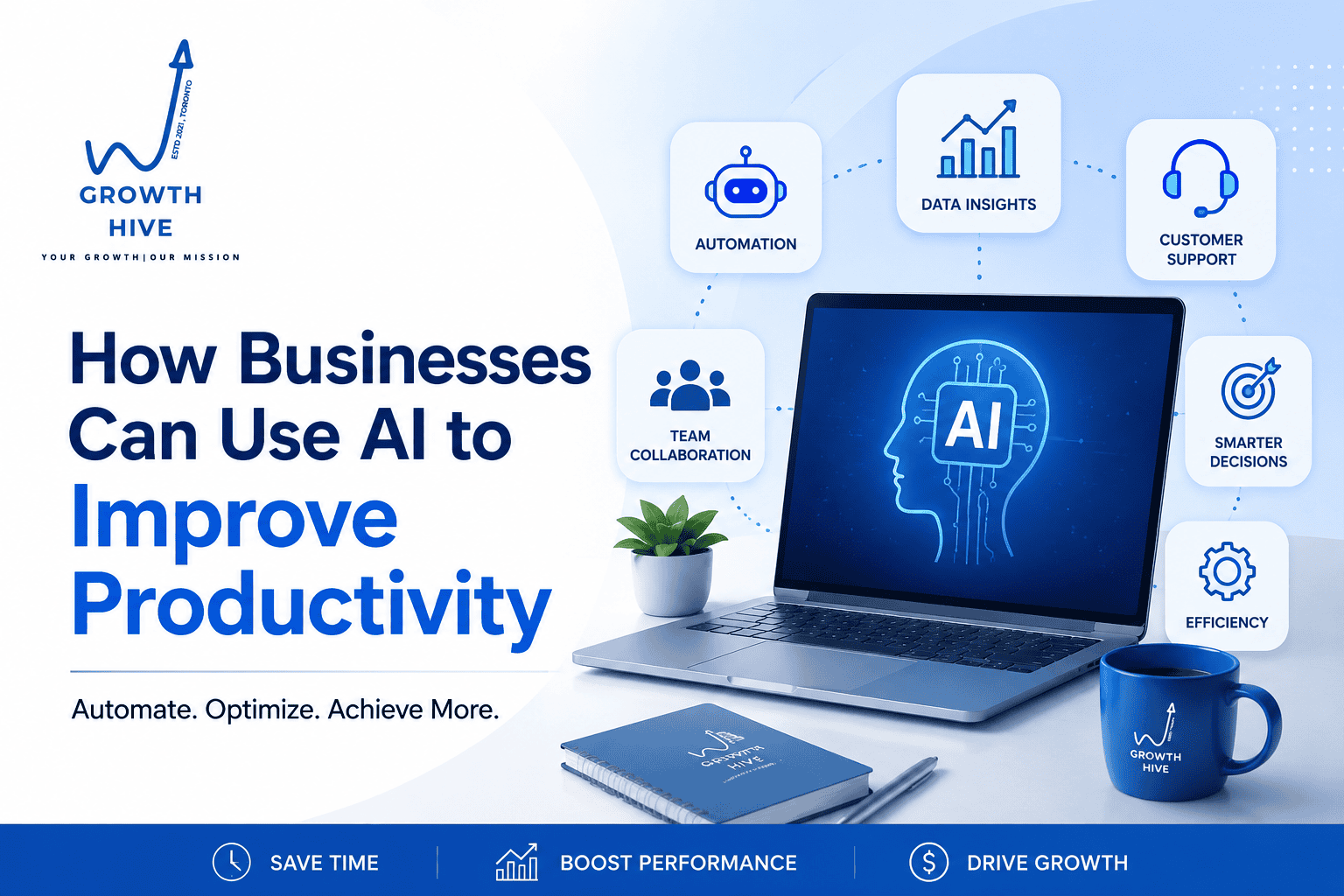
In today’s fast-paced business environment, companies are constantly searching for ways to work smarter, reduce operational costs, and stay ahead of competitors. One of the most effective solutions available today is artificial intelligence (AI). Once considered a futuristic technology, AI has now become an essential business tool that helps organizations streamline processes, improve decision-making, and increase overall productivity.
From automating repetitive tasks to enhancing customer service and data analysis, AI is transforming how businesses operate across industries. Whether you’re a startup, small business, or large enterprise, implementing AI strategically can significantly improve efficiency and performance.
What Is AI in Business?
Artificial intelligence refers to technology that enables machines and software to perform tasks that typically require human intelligence. These tasks include learning from data, recognizing patterns, making predictions, understanding language, and solving problems.
Businesses use AI-powered tools to automate workflows, analyze large datasets, assist customers, manage marketing campaigns, and optimize daily operations.
Why Productivity Matters in Modern Businesses
Productivity is one of the key factors that determine business success. Higher productivity means employees can accomplish more in less time while maintaining quality. Improved productivity also leads to:
- Reduced operational costs
- Faster project completion
- Better customer experiences
- Increased profitability
- More efficient resource allocation
- Enhanced employee satisfaction
AI helps businesses achieve these goals by handling routine tasks and allowing employees to focus on strategic and creative work.
Key Ways Businesses Can Use AI to Improve Productivity
1. Automating Repetitive Administrative Tasks
Many employees spend a significant portion of their workday performing repetitive administrative tasks such as:
- Data entry
- Invoice processing
- Scheduling meetings
- Email sorting
- Document management
AI-powered automation tools can complete these tasks quickly and accurately, reducing human error and freeing employees to focus on higher-value responsibilities.
For example, AI can automatically organize emails, generate reports, process forms, and update databases without manual intervention.
2. Enhancing Customer Support with AI Chatbots
Customer service teams often handle hundreds of repetitive inquiries daily. AI chatbots can instantly respond to common questions, provide product information, and assist customers 24/7.
Benefits include:
- Faster response times
- Reduced support workload
- Improved customer satisfaction
- Lower operational costs
AI chatbots can also escalate complex issues to human agents when necessary, ensuring customers receive appropriate assistance.
3. Improving Decision-Making Through Data Analysis
Businesses generate enormous amounts of data every day. Analyzing this information manually can be time-consuming and challenging.
AI-powered analytics tools help organizations:
- Identify trends
- Predict customer behavior
- Monitor performance metrics
- Forecast sales
- Detect inefficiencies
By turning raw data into actionable insights, AI enables business leaders to make faster and more informed decisions.
4. Streamlining Marketing Campaigns
Marketing teams can use AI to automate and optimize various marketing activities, including:
- Email marketing
- Content recommendations
- Audience targeting
- Ad optimization
- Customer segmentation
AI analyzes user behavior and engagement patterns to deliver personalized marketing messages that increase conversion rates and improve return on investment (ROI).
This allows marketers to focus more on strategy while AI handles data-driven optimizations.
5. Optimizing Human Resource Management
HR departments can use AI to simplify recruitment and employee management processes.
AI tools can:
- Screen resumes
- Schedule interviews
- Analyze candidate qualifications
- Track employee performance
- Assist with onboarding
This reduces administrative burden and helps HR professionals identify top talent more efficiently.
6. Increasing Workplace Collaboration
AI-powered collaboration tools help teams communicate and work together more effectively.
Features often include:
- Automated meeting summaries
- Task prioritization
- Smart scheduling
- Project management assistance
- Real-time transcription
By reducing communication gaps and administrative overhead, teams can stay aligned and productive.
7. Improving Inventory and Supply Chain Management
Businesses involved in manufacturing, retail, or logistics can benefit greatly from AI-powered supply chain solutions.
AI can:
- Forecast demand
- Monitor inventory levels
- Predict stock shortages
- Optimize delivery routes
- Reduce waste
Accurate forecasting helps businesses maintain optimal inventory levels while minimizing costs and operational disruptions.
8. Enhancing Cybersecurity and Risk Management
Cybersecurity threats continue to grow in complexity. AI helps businesses monitor systems continuously and identify suspicious activity in real time.
AI-driven security tools can:
- Detect unusual behavior
- Prevent data breaches
- Identify vulnerabilities
- Respond to threats faster
This proactive approach minimizes downtime and protects valuable business data.
9. Supporting Content Creation and Documentation
AI writing assistants help businesses create:
- Blog posts
- Product descriptions
- Social media content
- Email campaigns
- Internal documentation
While human oversight remains important, AI significantly reduces the time required to produce high-quality content.
This allows marketing and communication teams to scale content production without increasing workload.
10. Improving Financial Operations
Finance departments can use AI to automate many routine processes, including:
- Expense tracking
- Invoice management
- Budget forecasting
- Fraud detection
- Financial reporting
Automated financial workflows improve accuracy while reducing the time spent on manual calculations and data processing.
Benefits of AI for Business Productivity
Organizations that successfully implement AI often experience several advantages:
Faster Operations
AI completes repetitive tasks much faster than manual processes, allowing teams to accomplish more within the same timeframe.
Reduced Human Errors
Automation minimizes mistakes caused by manual data entry and repetitive work.
Better Resource Utilization
Employees can focus on strategic initiatives rather than spending hours on routine administrative tasks.
Improved Customer Experience
AI enables faster responses, personalized interactions, and better service delivery.
Increased Scalability
Businesses can handle larger workloads without proportionally increasing staff or operational costs.
Data-Driven Growth
AI provides valuable insights that support smarter business decisions and long-term growth strategies.
Challenges Businesses Should Consider
While AI offers significant benefits, businesses should also be aware of potential challenges:
- Initial implementation costs
- Employee training requirements
- Data privacy concerns
- Integration with existing systems
- Ongoing monitoring and optimization
A successful AI strategy requires careful planning and clear business objectives.
Best Practices for Implementing AI
To maximize the benefits of AI, businesses should:
- Identify repetitive processes suitable for automation.
- Start with small AI projects before scaling.
- Train employees on new technologies.
- Maintain human oversight where necessary.
- Monitor performance and adjust strategies regularly.
- Prioritize data security and compliance.
Taking a gradual and strategic approach can help businesses achieve sustainable results.
The Future of AI in Business Productivity
AI technology continues to evolve rapidly. Future advancements will make automation, predictive analytics, and intelligent decision-making even more accessible to businesses of all sizes.
Organizations that embrace AI today are positioning themselves for greater efficiency, innovation, and competitiveness in the years ahead.
Conclusion
Artificial Intelligence is no longer a luxury reserved for large corporations. Businesses of all sizes can use AI to improve productivity by automating routine tasks, enhancing customer service, streamlining operations, and supporting better decision-making.
When implemented strategically, AI empowers employees to focus on meaningful work while technology handles repetitive processes. As a result, companies can achieve higher efficiency, lower costs, and stronger business growth.
Investing in AI today can help businesses build a more productive, agile, and future-ready organization.


Leave a Reply