

Your Google Ads Are Getting Clicks. So Why Aren’t Customers Coming?
Imagine this.
You launch a Google Ads campaign.
The ads are approved.
People are clicking.
Your dashboard looks active.
You start thinking:
“Great. The campaign is working.”
Then you check your sales.
Nothing impressive.
A few inquiries came in, but most were irrelevant. Some people never responded. Others were simply looking for information. Your advertising budget is disappearing, but the number of actual customers isn’t growing at the same pace.
Sound familiar?
This is one of the biggest problems businesses face with Google Ads.
Getting attention isn’t the same as getting business.
A click is only a visitor.
A customer is someone who sees enough value, trust, relevance, and convenience to take the next step.
And that difference changes the way Google Ads should be managed.
The Google Search Happens Before Your Ad Does
Before someone clicks your advertisement, they already have a problem.
A homeowner might be searching:
“roof repair company near me”
A business owner might search:
“best accounting software for small business”
Someone ready to buy might search:
“buy office chairs online”
A company looking for marketing help might search:
“SEO agency for ecommerce business”
These aren’t random searches.
They represent intent.
And intent is one of the most valuable things Google Ads gives businesses access to.
You aren’t simply advertising to a large audience.
You can potentially appear when someone is actively looking for something related to what you sell.
But here’s the important part:
Not every searcher is your customer.
That’s where strategy begins.
The Problem Isn’t Always Your Google Ads
When a campaign underperforms, businesses often immediately blame:
- Keywords
- Competition
- Advertising costs
- The algorithm
- Their budget
Sometimes those things matter.
But sometimes the real problem is sitting somewhere else.
Your campaign may be attracting the wrong searches.
Your advertisement may not communicate your value.
Your landing page may create friction.
Your offer may be unclear.
Your conversion tracking may be measuring the wrong action.
Your sales team may not be following up quickly enough.
Or perhaps you’re measuring leads instead of customers.
That’s why looking only at your Google Ads dashboard can be misleading.
The real customer journey looks more like this:
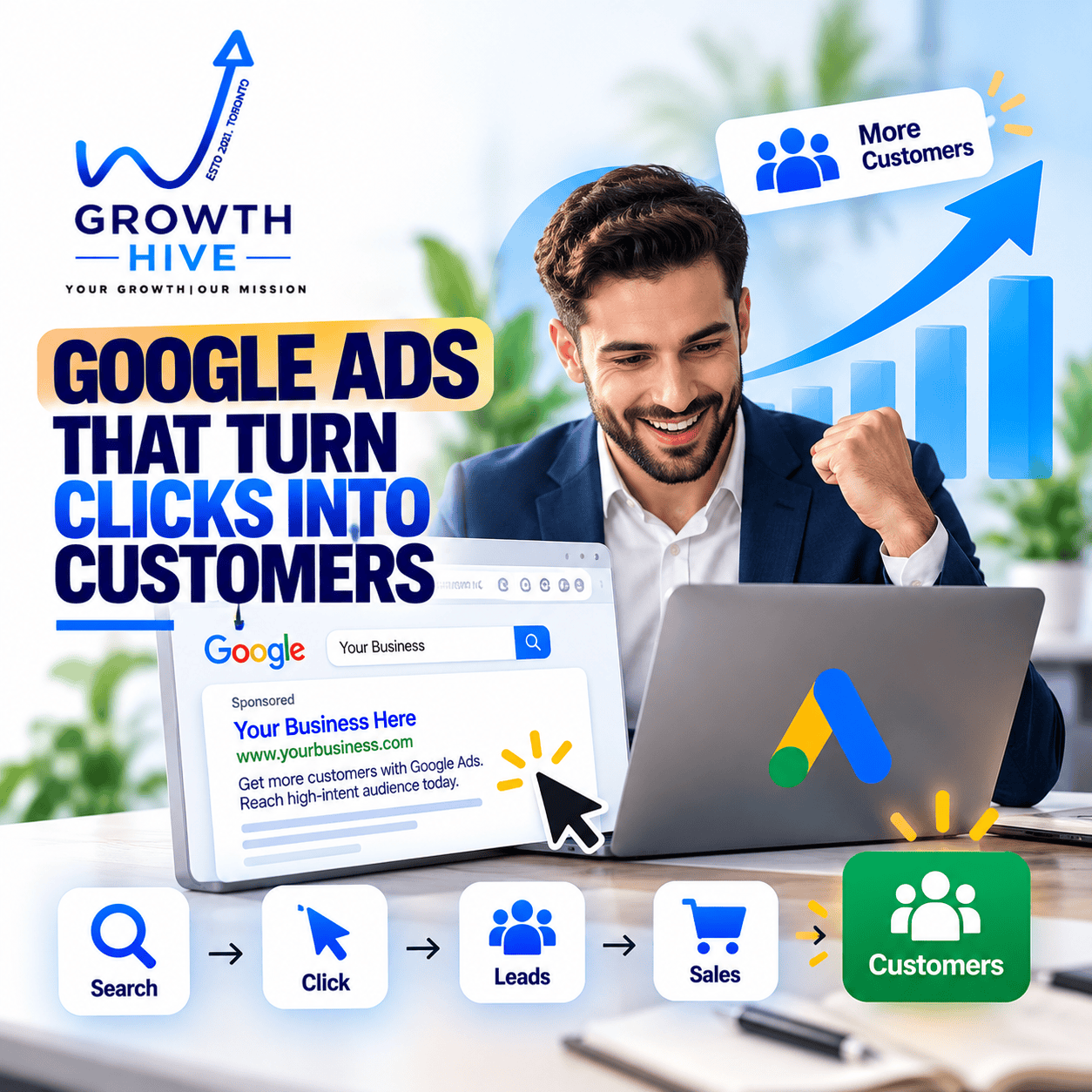
Search → Ad → Click → Landing Page → Action → Lead → Sales Process → Customer
If something breaks along that journey, advertising performance suffers.
A Click Doesn’t Pay Your Bills
Let’s say you spend $1,000 on Google Ads.
You receive:
1,000 clicks
That sounds impressive.
But what if only 20 people contact you?
And what if only 5 are actually qualified?
And what if only 2 become customers?
Now ask yourself:
Was the campaign successful because it generated 1,000 clicks?
Or should you investigate what happened between those clicks and those two customers?
This is why serious Google Ads management needs to move beyond surface-level metrics.
Clicks matter.
CTR matters.
Cost per click matters.
But ultimately, businesses care about things such as:
Leads. Sales. Revenue. Customers. Profitability.
The exact metric depends on the business.
Different Businesses Need Different Google Ads Strategies
There is no universal Google Ads campaign.
Consider these four businesses.
A Local Plumber
The objective may be phone calls and service bookings.
The customer might need help immediately.
The campaign should make it easy to call or request service.
An E-Commerce Brand
The objective may be product purchases.
The business needs to understand product-level performance, conversion value, and customer acquisition costs.
A B2B Software Company
A visitor may not purchase immediately.
The journey could be:
Ad → Demo → Sales Call → Proposal → Customer
The campaign therefore needs to account for a longer sales cycle.
A Real Estate Business
The goal might be qualified property inquiries.
Getting hundreds of low-quality inquiries isn’t necessarily useful if very few represent serious buyers.
Same advertising platform.
Completely different customer journeys.
That’s why your Google Ads strategy should start with your business model, not someone else’s campaign template.
The Question You Should Ask Before Choosing Keywords
Many businesses begin with:
“Which keywords should we target?”
A better question is:
“What is our potential customer trying to accomplish when they search?”
Compare these searches:
“What is digital marketing?”
and
“Digital marketing agency for small business”
They both relate to digital marketing.
But they don’t necessarily represent the same commercial intent.
The first person may be learning.
The second may be looking for a service provider.
That difference matters when you are paying for every click.
Your objective isn’t to collect as many searches as possible.
It is to identify searches that have a meaningful connection to your business.
Your Search Terms Can Tell You What Customers Really Want
Here’s something many businesses overlook.
You may choose the keywords.
But real users generate the searches.
And those searches can teach you a lot.
You may discover that people are searching for:
- A service you didn’t realize was in demand
- A specific product variation
- A location you weren’t targeting
- A particular problem
- A competitor
- Free alternatives
- Jobs
- Training
- Tutorials
- Completely unrelated services
That information is valuable.
Some searches deserve more attention.
Others deserve to be excluded.
This is where search-term analysis and negative keywords become important.
Instead of repeatedly paying for irrelevant traffic, you can use campaign data to understand where your advertising budget is actually going.
Then Comes the Ad
You’ve found the right search.
Now you have a few seconds to convince someone to click.
This is where generic advertising often falls flat.
Imagine searching:
“Emergency AC repair near me”
and seeing:
Professional AC Services
Quality Solutions
Contact Us Today
Then another company says:
Emergency AC Repair — Same-Day Service
Get Fast Help From Local Technicians
The second message immediately addresses the problem behind the search.
That’s what effective ad messaging should do.
It should connect:
Search intent + problem + solution + reason to act
Not simply fill every available character with marketing language.
And Then the Click Happens…
This is where many campaigns lose momentum.
The customer clicks your ad.
And lands on…
Your generic homepage.
Now they have to figure out:
- Where is the service?
- Do you operate in my area?
- How much does it cost?
- Why should I trust you?
- What should I do next?
- Where is the contact form?
Every additional question creates friction.
A better experience is to continue the conversation started by the advertisement.
If the ad says:
“Emergency Roof Repair”
the landing page should immediately make it clear:
“Yes, we provide emergency roof repair.”
Then show the information the customer needs and make the next action obvious.
Your Landing Page Is Part of Your Advertisement
This is an important mindset shift.
Google Ads doesn’t end when someone clicks.
Your landing page is part of the advertising experience.
A strong landing page should answer questions quickly:
What do you offer?
Who is it for?
Why should I choose you?
What makes your offer relevant?
What should I do next?
Depending on your business, the CTA could be:
Buy Now
Get a Quote
Book an Appointment
Request a Consultation
Call Now
Start Free Trial
Schedule a Demo
The right CTA depends on what happens next in your sales process.
More Leads Isn’t Always Better
Here’s another uncomfortable truth.
Sometimes a business doesn’t need more leads.
It needs better leads.
Imagine a marketing agency receives 100 inquiries.
After reviewing them, only 10 are suitable clients.
Another campaign generates 40 inquiries.
But 20 are suitable prospects.
Which campaign should receive more attention?
You cannot answer that by looking only at lead volume.
This is why businesses should connect advertising data with sales data whenever possible.
The real journey is:
Lead → Qualified Lead → Opportunity → Customer → Revenue
That is where Google Ads starts becoming a business growth tool rather than simply an advertising platform.
What Should You Actually Measure?
The answer depends on your business.
For a local service business:
Calls + bookings + qualified inquiries
For e-commerce:
Purchases + revenue + conversion value
For B2B:
Qualified leads + opportunities + customers
For SaaS:
Trials + activated users + paid accounts
For real estate:
Qualified property inquiries + appointments
For professional services:
Consultations + qualified prospects + signed clients
The important question isn’t:
“How many conversions did Google Ads generate?”
It’s:
“Which conversions actually matter to our business?”
This Is Where Conversion Tracking Becomes Critical
Imagine Google Ads is optimizing for form submissions.
But your form is being filled out by people who aren’t actually potential customers.
Google may see:
More conversions = better performance
Your sales team may see:
More irrelevant leads = more wasted time
That’s a disconnect.
Your conversion goals should reflect the actions that genuinely contribute to business results.
When tracking is accurate, your advertising data becomes much more useful.
You can start asking better questions:
- Which campaigns generate qualified prospects?
- Which services generate the most valuable customers?
- Which locations perform best?
- Which searches produce sales?
- Which landing pages convert?
- Where is the budget being wasted?
- Which customer segments are worth scaling?
Now you’re optimizing with business data—not assumptions.
Google Ads Can Become Smarter Over Time
One of the strengths of Google Ads is that campaigns can use automation and machine learning to help optimize bidding and delivery.
But automation doesn’t eliminate strategy.
Think of it this way:
Automation can help operate the engine.
But you still need to decide:
Where are we going?
If your campaign has inaccurate conversion tracking, unclear goals, poor landing pages, or irrelevant traffic, more automation doesn’t automatically solve those problems.
The system needs useful signals and a clear objective.
That’s why strategy, tracking, creative, targeting, and optimization still matter.
Don’t Increase the Budget Just Because You Want More Sales
This is another common mistake.
Campaign isn’t producing enough customers?
Increase budget.
Still not enough?
Increase budget again.
But what if the real problem is conversion rate?
Or targeting?
Or the offer?
Or lead quality?
Or the landing page?
Increasing spend can simply increase the amount of money you’re spending on the same problem.
A better approach is:
Find the constraint → Fix it → Measure the change → Scale when the numbers support it.
Sometimes the answer really is more budget.
But budget should follow performance—not replace optimization.
What a Strong Google Ads Process Looks Like
At a practical level, a well-managed campaign can follow a simple cycle.
01 — Understand the Business
Before touching the campaign, understand:
What do you sell?
Who buys it?
Where do they buy?
What makes the offer valuable?
What does a customer look like?
02 — Understand Search Intent
Identify the searches that indicate genuine interest in the product or service.
03 — Build Focused Campaigns
Organize campaigns around meaningful products, services, locations, or objectives.
04 — Write Relevant Ads
Make the advertisement match the customer’s problem and expectations.
05 — Build the Right Landing Experience
Don’t make potential customers hunt for the information they came for.
06 — Track What Matters
Measure meaningful business actions.
07 — Analyze Real Data
Look at:
Search terms → conversions → lead quality → sales → revenue
08 — Remove Waste
Use campaign data to identify irrelevant traffic and opportunities for improvement.
09 — Test
Test relevant elements such as:
- Messaging
- Offers
- Landing pages
- Calls to action
- Campaign structure
- Audience signals
- Budget allocation
10 — Scale
When the data shows that an opportunity is working, increase investment strategically.
Google Ads Isn’t About Being Everywhere
You don’t necessarily need your ads appearing for every possible search.
You need them appearing for the right searches.
That’s an important difference.
A smaller amount of highly relevant traffic can be more valuable than a huge amount of poorly targeted traffic.
The objective is not:
“Get as many clicks as possible.”
The objective is:
“Get the right potential customers to take the right action.”
And That’s Where Growth Hive Comes In
At Growth Hive, we look at Google Ads from the perspective of the entire business journey.
Not just:
How many clicks did we get?
But:
Who clicked?
Why did they click?
What happened after the click?
Did they become a lead?
Was the lead qualified?
Did the customer buy?
Was the acquisition valuable to the business?
Because your advertising budget deserves more than impressive dashboard numbers.
It deserves a strategy connected to your actual business objectives.
Whether you’re running a local business, e-commerce store, B2B company, SaaS platform, professional service, real estate business, healthcare practice, startup, or established brand, your Google Ads strategy should be built around your customers, your offer, your sales process, and your growth goals.
Stop measuring Google Ads by clicks alone.
Start connecting clicks to customers.
Growth Hive helps businesses build and optimize Google Ads campaigns designed around visibility, qualified traffic, conversions, and sustainable growth.
Your growth is the goal. The advertising should support it.


Leave a Reply