

Google Ads Should Do More Than Generate Clicks
Someone searches for a product or service your business offers.
Your advertisement appears.
They click.
You pay.
And then… nothing.
No inquiry.
No booking.
No purchase.
No phone call.
If you’ve ever looked at your Google Ads bill and wondered “Where did all that money go?”, you’re not alone.
One of the biggest misconceptions about Google Ads is that success means getting more clicks.
It doesn’t.
A click is simply someone opening the door.
The real question is:
What happens after they walk through it?
For a business, Google Ads should be connected to meaningful outcomes—qualified leads, sales, bookings, purchases, calls, or other valuable customer actions.
Google’s current guidance also emphasizes aligning bidding and conversion goals with the actual business objective, rather than treating every click as equally valuable.
That’s where strategic Google Ads management becomes important.
What Are Google Ads Services?
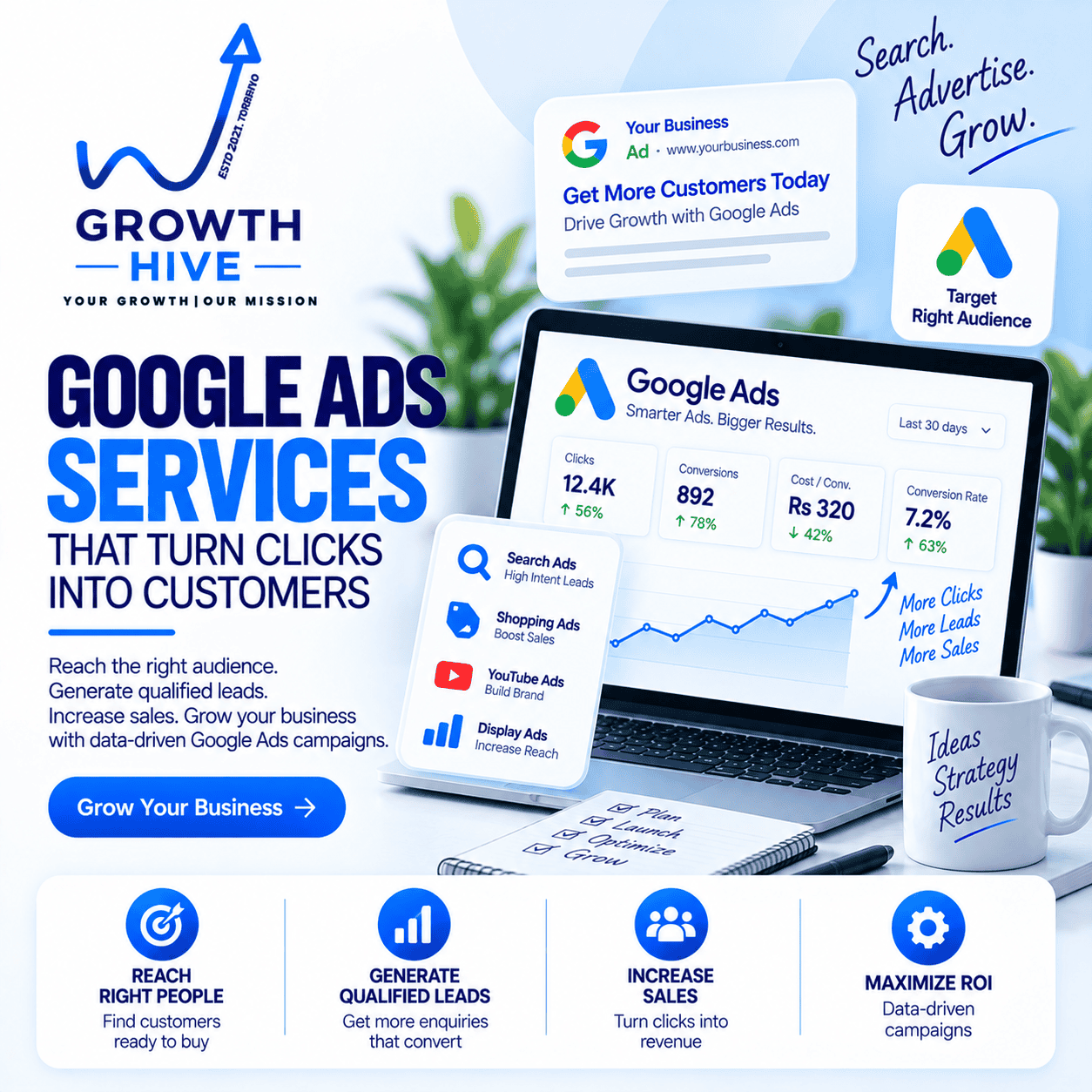
Google Ads services involve planning, creating, managing and optimizing paid advertising campaigns across Google’s advertising ecosystem.
Depending on the business, this can include:
- Search Ads
- Shopping campaigns
- Performance Max
- Display advertising
- YouTube advertising
- Remarketing
- Keyword research
- Audience targeting
- Conversion tracking
- Landing-page optimization
- Negative keyword management
- Bid strategy
- Campaign optimization
- Ad copywriting
- Performance reporting
But running Google Ads isn’t simply about creating a campaign and adding a budget.
The real work is understanding:
Who should see your ads?
What are they searching for?
What should you say to them?
Where should you send them?
What action should they take?
How valuable is that action to your business?
The Problems Businesses Face With Google Ads
Businesses usually don’t come to Google Ads because they want more advertising.
They come because they want to solve a problem.
Maybe:
- Your sales have slowed down.
- Your website isn’t generating enough enquiries.
- Your competitors appear above you.
- Your SEO isn’t producing enough traffic yet.
- Your sales team needs more leads.
- Your e-commerce store needs more purchases.
- You’re getting clicks but poor-quality enquiries.
- Your advertising costs are increasing.
- You don’t know which campaigns are actually profitable.
Google Ads can address these challenges—but only when campaigns are designed around the underlying business problem.
Problem 1: “We’re Getting Clicks, But No Customers”
This is probably the most frustrating Google Ads problem.
Your dashboard looks active.
You have impressions.
You have clicks.
Maybe even a respectable click-through rate.
But sales aren’t moving.
This usually means you need to look beyond the click.
Ask:
Are the right people clicking?
Are they seeing the right message?
Does the landing page match the advertisement?
Is the offer clear?
Is the conversion process easy?
Are conversions being tracked correctly?
Google recommends matching the landing page closely with the ad and keyword so visitors immediately find what they expected after clicking.
The customer journey needs to feel connected:
Search → Ad → Landing Page → Action
If one link breaks, money can be wasted.
Problem 2: You’re Paying for the Wrong Traffic
Imagine you sell premium accounting services to businesses.
Someone searches:
“free accounting software”
Your ad appears.
They click.
You pay.
But they’re looking for something completely different from what you sell.
That’s not a marketing victory.
It’s wasted traffic.
This is why search intent matters.
Google Ads should distinguish between searches that indicate:
Information
“Ideas for accounting”
Research
“Best accounting services for small business”
Commercial intent
“Accounting firm for small business”
Strong purchase intent
“Hire accountant for small business”
The closer the search is to the customer’s actual buying intent, the more meaningful the opportunity can become.
Problem 3: Your Competitors Keep Appearing Above You
You search for your own service.
Your competitor appears.
You search again.
Another competitor appears.
It can be frustrating.
But Google Ads isn’t simply a contest where the business willing to spend the most automatically wins.
Campaign structure, relevance, bidding, ad quality, targeting and landing-page experience all matter.
Instead of simply increasing your budget, examine:
- Which searches are valuable?
- Which campaigns generate qualified leads?
- Which keywords waste spend?
- Which ads attract relevant users?
- Which landing pages convert?
- Which locations perform?
- Which devices perform?
- Which audiences produce business value?
The goal isn’t to appear everywhere.
It’s to appear when the right customer is looking.
Problem 4: Your Leads Aren’t High Quality
Getting 100 leads sounds great.
Until your sales team starts calling them.
Then you discover:
- Wrong locations
- Wrong service requirements
- People looking for free solutions
- Job seekers
- Students
- Unqualified businesses
- People outside your target market
Suddenly, your “100 leads” aren’t particularly impressive.
That’s why businesses should measure qualified leads, not simply lead volume.
Your campaigns should reflect your actual customer criteria.
For example:
Location
Industry
Service requirement
Budget
Product type
Buying intent
Customer profile
The fewer irrelevant people entering the funnel, the more useful your sales team’s time becomes.
Problem 5: Your Landing Page Is Losing Customers
Your advertisement says:
“Get a Free Business Consultation.”
The customer clicks.
Instead of seeing a consultation page, they land on your homepage with 30 different links.
Now they have to figure out what to do.
That’s friction.
A dedicated landing page can be designed around the promise made in the advertisement.
If the ad says:
“Book a Free Consultation”
the landing page should make booking that consultation obvious.
Google specifically recommends maintaining strong relevance between the ad, keywords and landing page because visitors are more likely to leave when they don’t immediately find what they expected.
Problem 6: You’re Not Tracking the Right Conversions
This is one of the most important issues.
Suppose your business receives:
100 form submissions
But only:
20 are qualified leads
And only:
5 become customers.
If Google Ads is optimizing toward every form submission equally, the campaign may not understand which outcomes are actually valuable to the business.
Your conversion setup should reflect meaningful actions.
Depending on the business, that could include:
- Purchases
- Qualified leads
- Phone calls
- Bookings
- Demo requests
- Sign-ups
- Revenue
- Subscription value
Google’s current guidance emphasizes using accurate conversion data and aligning conversion goals with the business objective when using Smart Bidding.
Enhanced Conversions Can Improve Measurement
Google Ads currently provides Enhanced Conversions, which can improve conversion measurement by supplementing existing conversion tags with securely hashed first-party customer data.
Google states that enhanced conversions can improve measurement accuracy and support more informed bidding.
For businesses that depend heavily on lead generation or online sales, better measurement can be important because optimization is only as useful as the data behind it.
If your system can’t distinguish a valuable customer from an insignificant action, optimization becomes much harder.
Problem 7: You’re Spending Too Much on Ads
The first reaction is often:
“Reduce the budget.”
But reducing spend isn’t always the answer.
You need to understand where the money is going.
Look at:
- Search terms
- Keywords
- Campaigns
- Locations
- Devices
- Audiences
- Products
- Landing pages
- Conversion rates
- Customer value
Google’s Search terms report helps advertisers see the searches that triggered ads and identify relevant opportunities or irrelevant searches that may need to be excluded.
Sometimes the solution isn’t spending less.
It’s spending more intelligently.
Negative Keywords: Stop Paying for Irrelevant Searches
Negative keywords can help prevent ads from appearing for searches that aren’t relevant to your business.
For example, if you sell paid professional services, you may want to exclude searches involving:
- Free
- Jobs
- Careers
- Courses
- Training
—but only when those terms are genuinely irrelevant to your specific business.
Google recommends using negative keywords to exclude unwanted search terms and improve traffic relevance.
This is one reason ongoing campaign management matters.
Search behavior changes.
New irrelevant searches appear.
New opportunities also appear.
Your campaigns need to learn from both.
Broad Match Isn’t Simply “Bad”
Some businesses still assume broad match automatically means irrelevant traffic.
That’s too simplistic.
Google currently recommends pairing broad match with Smart Bidding, where bidding is optimized at auction time using contextual signals and conversion goals.
Broad match can help businesses discover additional relevant searches beyond exact or phrase matching.
But that doesn’t mean:
“Turn on broad match and forget everything.”
You still need:
- Accurate conversion tracking
- Strong conversion goals
- Search-term analysis
- Appropriate exclusions
- Relevant landing pages
- Ongoing optimization
Automation works best when it has good objectives and useful data.
Google Ads for Local Businesses
Local businesses can benefit from Google Ads when customers are actively searching for nearby services.
Consider:
- Dentists
- Restaurants
- Property consultants
- Lawyers
- Clinics
- Salons
- Plumbers
- Real estate businesses
- Home services
- Educational institutions
Someone searches:
“property consultant near me”
or:
“dentist in Hyderabad”
or:
“AC repair near me.”
The business doesn’t need to reach everyone in the country.
It needs to reach the people it can actually serve.
Local campaign strategy can consider:
- Service areas
- Location targeting
- Local search intent
- Call conversions
- Location-specific landing pages
- Local offers
- Business hours
The objective is simple:
Reach customers where you can actually do business.
Google Ads for E-Commerce Businesses
For online stores, Google Ads can help customers discover products when they’re actively shopping.
Campaigns can support:
- Product discovery
- Shopping journeys
- Brand searches
- Category searches
- Remarketing
- Repeat purchases
But e-commerce advertising shouldn’t be judged only by clicks.
You need to understand:
What did the customer buy?
How much revenue did it generate?
What did it cost to acquire them?
What is the product margin?
Are customers returning?
For businesses with different product values or margins, conversion value can be particularly important.
Google provides value-based bidding options such as Maximize conversion value and Target ROAS for campaigns where the value of conversions matters.
Google Ads for B2B Businesses
B2B advertising can be challenging because the person who clicks the advertisement may not immediately become a customer.
The journey might be:
Search → Website → Research → Consultation → Proposal → Internal Approval → Purchase
That’s very different from buying a pair of shoes.
Your campaigns should therefore consider the complete sales cycle.
Useful conversion actions may include:
- Demo requests
- Consultation bookings
- Quote requests
- Contact forms
- Qualified leads
- Sales opportunities
And if your business can connect marketing leads with actual sales outcomes, that information can make advertising optimization much more meaningful.
Google Ads for Professional Services
Professional services depend heavily on trust.
Potential customers may search for:
- Accountants
- Lawyers
- Consultants
- Architects
- Financial professionals
- Marketing agencies
- Healthcare providers
Your advertisement needs to communicate:
What you offer
Who you help
Why you’re relevant
What the customer should do next
But the website needs to reinforce that message.
Useful trust elements can include:
- Testimonials
- Case studies
- Credentials
- Experience
- Clear service information
- FAQs
- Contact options
An advertisement can create interest.
Your website needs to turn that interest into confidence.
Google Ads for Startups
Startups often have limited budgets.
That makes targeting especially important.
Instead of trying to advertise everywhere, identify:
Who is most likely to become a customer?
Then build campaigns around their problems and search behavior.
A startup can use Google Ads to test:
- Messaging
- Customer segments
- Offers
- Keywords
- Landing pages
- Geographic markets
The resulting data can also inform broader marketing decisions.
Paid search isn’t only an acquisition channel.
It can become a source of customer-intent data.
International Google Ads Campaigns
Selling internationally introduces another layer of complexity.
Different countries may have different:
- Search behavior
- Languages
- Competition
- Purchasing power
- Regulations
- Customer expectations
- Product demand
A campaign that performs well in one country doesn’t automatically deserve the same budget in another.
International campaigns should be evaluated market by market.
This can mean creating different:
- Campaign structures
- Keywords
- Ad copy
- Landing pages
- Offers
- Budgets
Your business may be global.
Your advertising shouldn’t be blindly identical everywhere.
Your Ad Copy Needs to Speak to the Customer
People don’t click advertisements because businesses have “solutions.”
They click because something matters to them.
Instead of:
“Leading Digital Solutions Provider”
you could communicate:
“Get More Qualified Leads From Google Ads.”
Instead of:
“Premium Property Services.”
you might communicate:
“Find Verified Properties With Local Experts.”
The message should connect to:
Problem → Benefit → Action
Your customer should understand the value quickly.
Emotional Relevance Matters
Google Ads can feel very technical.
Keywords.
Bids.
CTR.
CPA.
ROAS.
Conversions.
But behind every search is a person.
Someone might be searching because they’re:
Worried about losing customers.
Frustrated with their current provider.
Trying to save time.
Looking for a better price.
Trying to grow their business.
Looking for help right now.
A good advertisement doesn’t exploit those emotions.
It simply acknowledges the problem and presents a relevant solution.
That’s what makes advertising feel human rather than robotic.
Don’t Send Every Customer to Your Homepage
Your homepage has many jobs.
Your advertisement has one.
If someone searches for:
“Google Ads management for small businesses”
and clicks your ad, sending them to a generic homepage may create unnecessary friction.
A dedicated landing page can focus on:
- The exact service
- The customer problem
- Benefits
- Proof
- FAQs
- Objection handling
- CTA
The closer the journey is:
Search → Ad → Relevant Page → Action
the easier it is for the customer to understand what to do next.
Google Ads and SEO Should Work Together
Paid search and SEO aren’t necessarily competitors.
They can support each other.
Google Ads can provide immediate visibility for valuable searches.
SEO can build organic visibility over time.
Paid search data can reveal:
- Customer language
- Search terms
- Commercial intent
- Offers that attract clicks
- Landing pages that convert
Those insights can inform your wider content and SEO strategy.
Likewise, strong organic pages can support paid campaigns when they’re relevant and conversion-focused.
Google Ads and Social Media Can Work Together
Someone may first discover your business through social media.
Later, they search your brand on Google.
Another person might click your Google Ad, leave, and later see your social content.
Customers don’t necessarily follow a straight line.
A connected marketing strategy can use:
Google Ads + SEO + Social Media + Email + Website
to support different stages of the customer journey.
What Should You Measure?
Clicks are useful.
But they’re only one part of the picture.
Depending on your business, important metrics can include:
Conversion Rate
How many visitors take the desired action?
Cost Per Lead
How much does each lead cost?
Cost Per Qualified Lead
How much are you paying for leads that actually fit your customer profile?
Cost Per Acquisition
What does it cost to acquire a customer?
ROAS
How much revenue is generated relative to advertising spend?
Conversion Value
What monetary value is being attributed to conversions?
Search Terms
What are people actually searching for?
Landing Page Performance
Where are customers converting—or leaving?
Customer Quality
Are the leads becoming actual customers?
The right metric depends on the business model.
Don’t Optimize for Cheap Leads
This is worth repeating.
A lead costing $10 isn’t automatically better than a lead costing $50.
Imagine:
Lead A: $10
Never responds.
Lead B: $50
Becomes a $5,000 customer.
Which one created more business value?
The answer depends on your economics, but the example illustrates the problem with optimizing purely for low cost.
Cheap isn’t the same as valuable.
Your Google Ads strategy should reflect the economics of your business.
Google Ads Requires Continuous Optimization
Launching a campaign is not the finish line.
It’s the beginning.
A professional campaign should be reviewed regularly for:
- Search terms
- Keywords
- Negative keywords
- Ad performance
- Landing pages
- Conversion data
- Budget allocation
- Geographic performance
- Device performance
- Audience signals
- Product performance
Google’s own guidance recommends setting up campaigns around clear objectives, using accurate conversion data, selecting an appropriate bidding strategy and evaluating performance over time.
The market doesn’t stand still.
Your campaigns shouldn’t either.
Common Google Ads Mistakes
Choosing Keywords Based Only on Search Volume
High volume doesn’t guarantee high business value.
Measuring Success by Clicks
Clicks are not customers.
Ignoring Search Terms
Actual search behavior can reveal both waste and opportunities.
Sending Everyone to the Homepage
Relevant landing pages can create a more connected customer journey.
Tracking the Wrong Conversions
If your conversion data doesn’t reflect business value, optimization becomes harder.
Using the Same Campaign for Every Market
Different audiences can have different search behavior.
Ignoring Negative Keywords
Irrelevant searches can consume budget.
Changing Everything Too Frequently
Campaigns need enough consistency to generate useful learning.
Forgetting About the Sales Team
Marketing leads are only valuable if the business can actually convert them.
A Better Google Ads Strategy for Businesses
A practical process can look like this:
1. Define the Business Goal
Do you need:
- Leads?
- Sales?
- Bookings?
- Calls?
- Store visits?
- Revenue?
- App installs?
2. Understand the Customer
Identify who you’re trying to reach and what they search for.
3. Map Search Intent
Separate research-oriented searches from strong commercial intent.
4. Build the Campaign
Create relevant campaigns, ad groups, targeting and messaging.
5. Create Relevant Landing Pages
Match the landing experience to the advertisement and customer intent.
6. Configure Conversion Tracking
Measure meaningful customer actions.
7. Choose the Appropriate Bidding Strategy
Google’s Smart Bidding options are designed around goals such as maximizing conversions or conversion value, with strategies such as Maximize Conversions, Target CPA, Maximize Conversion Value and Target ROAS.
8. Analyze Search Behavior
Use search-term data to identify opportunities and irrelevant traffic.
9. Optimize
Improve ads, keywords, landing pages, budgets and targeting based on evidence.
10. Connect Marketing With Sales
Understand which leads actually become customers.
That’s how Google Ads moves from:
“We’re running advertisements.”
to:
“We’re building a measurable customer acquisition system.”
Google Ads Should Work for the Business—Not Just the Dashboard
A beautiful Google Ads dashboard can still hide a serious problem.
You can have:
High impressions
High clicks
Low cost per click
and still have poor business results.
That’s why the most important question isn’t:
“How did our ads perform?”
It’s:
“What did our advertising do for the business?”
Did it create qualified opportunities?
Did it generate customers?
Did it increase revenue?
Did it reach the right market?
Did it help the sales team?
Those are the questions that matter.
Turn Search Intent Into Business Growth
Every day, potential customers search Google for products, services and solutions.
Some are simply researching.
Others are comparing.
Some are ready to buy.
The opportunity is to understand which searches matter to your business and build a customer journey around them.
At Growth Hive, we help businesses approach Google Ads as more than a paid traffic channel.
Whether you’re a local business, e-commerce brand, B2B company, startup, professional service provider, real estate business, healthcare organization or established company, your campaigns should be aligned with your customers, offers and commercial goals.
Our approach can connect:
Research → Targeting → Ad Copy → Landing Pages → Conversion Tracking → Optimization → Business Results
Because getting clicks is easy to measure.
Getting the right people to take meaningful action is where Google Ads becomes valuable.
Ready to get more from your Google Ads?
If you’re spending on Google Ads but aren’t confident that you’re attracting the right customers, talk to Growth Hive and identify where your campaigns can become more focused, measurable and aligned with your business goals.


Leave a Reply