
Email Marketing Is More Than Sending Emails
You have a customer database.
You have leads.
You have previous customers.
You may even have thousands of subscribers.
But how much business are those contacts actually generating?
This is where many businesses struggle with email marketing.
They send newsletters occasionally. They announce promotions. They share company updates. They might even see a healthy number of email opens.
Yet the sales don’t follow.
The problem usually isn’t email itself.
The problem is using email without a clear strategy.
Effective email marketing should help a business move people from interest to action, from first purchase to repeat purchase, and from one-time interaction to long-term relationship.
Whether you’re running a local service business, e-commerce store, B2B company, startup, professional practice, or established organization, email can become a direct and measurable communication channel with the people who already know—or are beginning to know—your business.
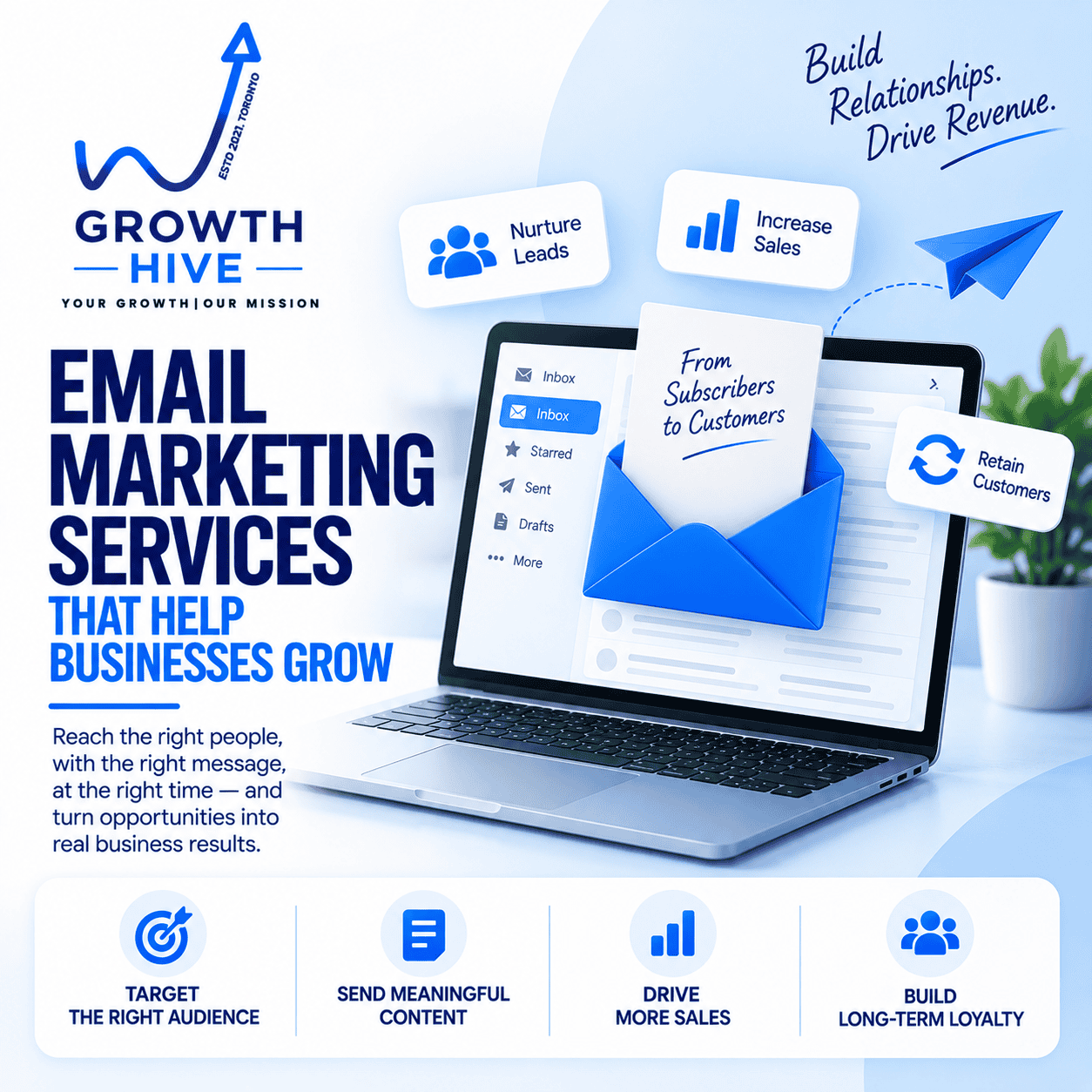
At Growth Hive, we approach email marketing as part of your wider growth strategy, with the focus on relevance, relationships, conversions, and measurable business outcomes.
Why Businesses Still Need Email Marketing
Social media can help you reach an audience.
Search can help customers discover you.
Paid advertising can generate immediate traffic.
But email gives you something particularly valuable:
A direct communication channel with people who have chosen to hear from your business.
That audience can include:
- Potential customers
- Existing customers
- Previous customers
- Newsletter subscribers
- People who downloaded a resource
- People who requested information
- Trial users
- Members
- Repeat buyers
Instead of constantly paying to reach the same people again, you can build an ongoing relationship with your audience.
And that’s where email marketing becomes much more than a promotional tool.
The Biggest Email Marketing Problems Businesses Face
Before talking about campaigns and automation, let’s talk about the problems.
Because businesses don’t need email marketing simply because it’s a popular marketing channel.
They need it because something isn’t working.
Maybe you have leads that never receive proper follow-up.
Maybe customers purchase once and disappear.
Maybe your emails get opened but rarely generate clicks.
Maybe your database has thousands of contacts but almost no engagement.
Maybe your sales team spends too much time manually following up.
Maybe your emails feel generic.
Maybe you don’t know which campaigns are actually generating revenue.
These are all solvable problems, but each requires a different approach.
Problem 1: “People Open My Emails, But Nobody Buys”
This is a classic email marketing problem.
Your subject line works.
People open the email.
But then they don’t do anything.
The mistake is assuming that an open automatically means interest.
It doesn’t.
The email still needs to be answered:
Why should I care?
Why is this relevant to me?
What problem does this solve?
Why should I take action?
What happens if I click?
A strong email connects the subject line with a useful message and a clear next step.
For example, instead of sending:
“Our New Services Are Available!”
You could lead with the customer’s actual problem:
“Still losing leads after they visit your website?”
The second message starts a conversation around a problem.
That’s what good email copy should do.
Problem 2: You’re Sending the Same Email to Everyone
Your audience isn’t one person.
A new lead isn’t the same as a loyal customer.
A customer who purchased yesterday isn’t the same as someone who hasn’t purchased in two years.
Yet many businesses send everyone the exact same email.
That’s where segmentation becomes important.
You can segment audiences based on factors such as:
- Previous purchases
- Location
- Interests
- Industry
- Customer status
- Website activity
- Email engagement
- Lead source
- Purchase frequency
- Product interest
Then your communication can become more relevant.
A customer doesn’t need more emails.
They need more relevant emails.
Problem 3: Leads Are Falling Through the Cracks
Imagine someone fills out your website form.
They’re interested.
They’ve taken the first step.
Then what happens?
If the only follow-up is:
“Thanks, we’ll contact you.”
You may be missing a major opportunity.
Email automation can keep the conversation moving while your sales team handles the human part of the process.
For example:
Day 1
Thank them for getting in touch.
Day 2
Explain how your service solves their problem.
Day 4
Share a relevant case study.
Day 6
Answer a common objection.
Day 8
Invite them to book a consultation.
This doesn’t replace sales.
It supports sales.
Problem 4: Customers Buy Once and Never Return
Acquiring a new customer can require significant marketing effort.
So why stop communicating after the first purchase?
For many businesses, the second purchase can be just as important as the first.
Email can help businesses create post-purchase journeys such as
Purchase → Education → Support → Recommendation → Repeat Purchase
For example, an e-commerce company selling skincare products could send:
Order confirmation
↓
How to use your product
↓
Helpful skincare tips
↓
Related product recommendation
↓
New product announcement
The communication feels natural because it follows the customer’s experience.
Problem 5: Abandoned Carts Are Costing You Sales
Someone adds a product to their cart.
They start checkout.
Then they leave.
This happens for many reasons.
Maybe they got distracted.
Maybe they wanted to compare prices.
Maybe shipping costs were unexpected.
Maybe they weren’t ready to purchase.
An abandoned-cart email gives your business another opportunity to bring that customer back.
Instead of allowing the customer to disappear completely, you can remind them about the product and address potential concerns.
A well-designed recovery sequence can include:
- Cart reminder
- Product benefits
- Reviews or social proof
- Shipping information
- Frequently asked questions
- Incentive where appropriate
The objective isn’t to pressure everyone into buying.
It’s to recover customers who were already showing purchase intent.
Problem 6: Your Emails Feel Too Promotional
Nobody wants their inbox to become a constant stream of:
BUY NOW!
LAST CHANCE!
50% OFF!
BUY NOW!
Promotional campaigns have their place.
But if every email is selling, your audience may stop paying attention.
A healthier email strategy mixes commercial content with useful information.
Depending on your industry, you might share:
- Practical advice
- Industry insights
- Educational guides
- Product tutorials
- Case studies
- Customer stories
- Frequently asked questions
- Useful resources
- New developments
Then when you make an offer, your audience understands the context.
Trust makes selling easier.
Email Marketing for Local Businesses
Email marketing can be surprisingly valuable for businesses serving a specific location.
Consider:
- Restaurants
- Clinics
- Salons
- Gyms
- Real estate businesses
- Property consultants
- Home service providers
- Local retailers
- Educational institutions
- Professional services
A local business can use email to stay connected with its community.
For example:
New service announcement
Seasonal promotion
Appointment reminder
Local event
Customer loyalty offer
Referral campaign
Review request
Helpful local advice
You don’t necessarily need a huge database.
You need an audience that is relevant and engaged.
Email Marketing for E-Commerce Businesses
E-commerce businesses can use email throughout the customer lifecycle.
Before Purchase
- Welcome campaigns
- Product education
- Recommendations
- Offers
- Reviews
During the Buying Journey
- Cart reminders
- Checkout communication
- Product information
After Purchase
- Order follow-up
- Product education
- Review requests
- Cross-sells
Long-Term
- Loyalty campaigns
- New products
- Personalized recommendations
- Re-engagement
This makes email particularly useful for increasing customer lifetime value, not simply generating one transaction.
Email Marketing for B2B Companies
B2B sales can take time.
A prospect might not be ready to buy when they first discover your company.
They may need to:
- Research solutions
- Compare providers
- Discuss internally
- Secure a budget
- Get management approval
- Evaluate technical requirements
Email nurturing allows you to remain useful during that process.
Instead of repeatedly asking:
“Are you ready to buy?”
you can provide information that helps the prospect make a better decision.
That could include:
- Industry insights
- Case studies
- Research
- Guides
- Product information
- Common mistakes
- Implementation advice
- FAQs
- Customer results
The goal is to move the prospect from:
“I’m researching.”
to:
“This company understands our problem.”
and eventually:
“Let’s have a conversation.”
Email Marketing for Professional Services
Professional services often have a long consideration period.
Someone might need:
- An accountant
- A consultant
- A lawyer
- An architect
- A marketing agency
- A financial professional
- A healthcare provider
But they may not hire immediately.
Email allows you to remain visible while building credibility.
You can demonstrate expertise through:
- Educational content
- Industry updates
- Case studies
- Client success stories
- Practical recommendations
- Expert insights
When the customer is finally ready, your business isn’t unfamiliar.
You’ve already been helping them.
Email Marketing for Startups
Startups often focus heavily on acquiring new users.
But acquisition is only one part of growth.
Once someone signs up, downloads something, requests a demo or starts a trial, what happens next?
Email can help guide that person through the early customer journey.
For example:
Welcome
↓
Explain the product
↓
Help them get started
↓
Show key benefits
↓
Answer common questions
↓
Encourage activation
↓
Offer support
The objective is to reduce the gap between:
“I signed up.”
and:
“I’m actually using this.”
Automation Makes Email Marketing Scalable
One of the strongest advantages of email marketing is automation.
Your team doesn’t need to manually send every message.
Certain customer actions can trigger relevant communication.
For example:
New Subscriber
→ Welcome sequence
New Lead
→ Lead nurturing
Product Purchase
→ Post-purchase sequence
Abandoned Cart
→ Recovery emails
Inactive Customer
→ Re-engagement campaign
New Product
→ Product announcement
Customer Anniversary
→ Loyalty message
Automation helps businesses maintain consistent communication without turning every follow-up into a manual task.
What Is an Email Funnel?
An email funnel is essentially a planned journey that moves someone toward a specific business outcome.
A simple funnel might look like:
Awareness
“Here’s a problem you may be facing.”
↓
Education
“Here’s why it happens.”
↓
Solution
“Here’s how to solve it.”
↓
Trust
“Here’s how we’ve helped others.”
↓
Conversion
“Here’s what you can do next.”
↓
Retention
“Here’s how we can continue helping you.”
The exact journey will differ between businesses.
But the principle remains:
Every email should move the customer somewhere useful.
Personalization Is More Than Using a First Name
Adding:
“Hi Sarah,”
isn’t enough to make an email personalized.
Real personalization means making the message more relevant to the recipient.
For example, if someone previously purchased a particular product, your next email could reflect that purchase.
If a prospect downloaded a guide about SEO, you could send related information rather than an unrelated promotion.
If a customer hasn’t purchased in a year, a re-engagement message makes more sense than treating them like a recent buyer.
The objective is simple:
Make the recipient feel like the message makes sense for them.
Email Copywriting Matters
Even the best strategy can fail if the email itself is difficult to read.
Good email copy should be:
- Clear
- Human
- Relevant
- Concise
- Persuasive
- Easy to scan
Talk about the customer’s problem.
Explain the benefit.
Remove unnecessary complexity.
Give them a reason to act.
And don’t be afraid to sound like a human being.
Your customers don’t want to read corporate language.
They want to understand:
“How does this help me?”
Your Call to Action Should Be Clear
One of the easiest ways to weaken an email is to make the next step unclear.
Instead of:
“Submit”
you might say:
“Get My Free Quote”
Instead of:
“Click Here”
you might use:
“Explore the Collection”
Instead of:
“Learn More”
you could say:
“Book Your Consultation”
The CTA should tell the customer what happens next.
Email Design Matters—But Don’t Overdesign
A professional email should look good.
But design should support the message rather than compete with it.
Good email design considers:
- Mobile responsiveness
- Readability
- Visual hierarchy
- Clear CTAs
- Appropriate images
- Brand consistency
- Accessible layouts
Sometimes a beautifully designed email is less effective than a simple, well-written message.
The question isn’t:
“Does this email look impressive?”
It’s:
“Does this email make the customer want to act?”
Email Deliverability Is Part of Marketing
You can create an incredible campaign.
But if it doesn’t reach the inbox, none of it matters.
Email deliverability involves factors such as:
- Sender reputation
- List quality
- Authentication
- Engagement
- Bounce rates
- Spam complaints
- Sending practices
- Subscriber consent
This is why buying random email lists can be a terrible idea.
A large list isn’t necessarily valuable.
A healthy list of people who actually want to hear from you is much more useful.
Don’t Ignore Your Inactive Subscribers
Over time, some subscribers stop engaging.
They may have changed jobs.
Their interests may have changed.
They may no longer need your product.
Or they may simply have stopped paying attention.
Instead of repeatedly sending campaigns to everyone, businesses can use re-engagement campaigns.
For example:
“Still interested in hearing from us?”
You can offer the subscriber an opportunity to remain engaged—or give them an easy way to leave.
This keeps your database healthier and your communication more relevant.
A/B Testing Helps You Stop Guessing
You don’t need to assume that one email will perform better.
Test it.
You can experiment with:
- Subject lines
- CTAs
- Headlines
- Offers
- Content length
- Images
- Personalization
- Send timing
- Email structure
For example:
A: “Your website could be losing customers”
B: “How many customers is your website losing?”
The objective isn’t to test for the sake of testing.
It’s to learn what resonates with your audience.
What Should Businesses Measure?
Email marketing shouldn’t be judged only by open rates.
Depending on the campaign, useful metrics can include:
Click-Through Rate
Are people engaging with your content?
Conversion Rate
Are recipients taking the intended action?
Revenue
How much business is the campaign generating?
Leads
Is email creating qualified opportunities?
Unsubscribe Rate
Are you sending content that people don’t find relevant?
Bounce Rate
Is your database healthy?
Customer Lifetime Value
Are email campaigns helping generate repeat business?
Return on Investment
Is the channel producing more value than it costs?
The most important question remains:
Is email contributing to business growth?
Email Marketing Should Connect With Your Website
Your email campaign doesn’t exist in isolation.
Someone receives your email.
They click.
They land on your website.
Then they decide whether to:
- Buy
- Book
- Contact
- Register
- Download
- Leave
If the email is excellent but the landing page is confusing, you’ve still lost the opportunity.
That’s why email marketing and website optimization should work together.
Email creates the opportunity.
Your website should help close it.
Email Marketing Should Work With SEO, PPC and Social Media
Your customer doesn’t care which marketing channel brought them to your business.
They simply experience your brand.
Someone might discover you through SEO.
Then see your Google Ad.
Later follow you on social media.
Then subscribe to your email list.
A few weeks later, they receive a useful email and finally become a customer.
That’s why email can become the connection between different marketing channels.
Your wider strategy can combine:
- SEO
- Google Ads
- Social media
- Content marketing
- Website development
- Email marketing
- Conversion optimization
Instead of operating separate marketing activities, you build a connected customer journey.
Common Email Marketing Mistakes
Sending Too Frequently
More emails don’t automatically mean more sales.
Sending Too Infrequently
If customers never hear from you, they may forget you.
Talking Only About Your Business
Your audience cares about their problems and goals.
Using One Message for Everyone
Segmentation creates relevance.
Having No Clear CTA
Don’t make customers guess what to do next.
Ignoring Mobile
A difficult mobile experience can destroy otherwise good campaigns.
Buying Email Lists
Quantity is not quality.
Ignoring Deliverability
If your messages don’t reach the inbox, your strategy cannot perform.
Measuring Vanity Metrics
Opens and clicks matter, but revenue and qualified actions matter more.
Never Testing
Your first version doesn’t have to be your final version.
What Should a Professional Email Marketing Service Include?
When businesses outsource email marketing, they should look beyond simply asking:
“How many emails will you send each month?”
A professional service should consider the entire system.
Strategy
Define the commercial objective.
Audience Research
Understand who you’re communicating with.
Segmentation
Group audiences according to meaningful characteristics.
Copywriting
Create clear, persuasive and human messaging.
Design
Build professional, responsive emails.
Automation
Create customer journeys that work consistently.
Campaign Management
Plan and execute campaigns around business priorities.
Testing
Identify opportunities to improve performance.
Analytics
Understand what generates meaningful results.
Optimization
Keep improving based on actual performance.
That’s the difference between sending emails and running email marketing.
How Email Marketing Solves Different Business Goals
| Business Concern | Email Marketing Opportunity |
|---|---|
| Not enough repeat customers | Retention campaigns |
| Leads aren’t converting. | Lead nurturing |
| Abandoned carts | Recovery sequences |
| Low engagement | Segmentation & personalization |
| Customers forget the business. | Consistent communication |
| The sales team lacks follow-up. | Automated sequences |
| The new product needs promotion. | Product launch campaigns |
| Old customers have disappeared. | Re-engagement campaigns |
| Customers need education. | Helpful content sequences |
| Marketing results are unclear. | Conversion & revenue tracking |
The strategy changes according to the problem.
That’s why a one-size-fits-all email package rarely delivers the best outcome.
The Future of Email Marketing Isn’t More Emails
It’s more relevant communication.
Customers are becoming better at ignoring generic marketing.
They don’t want another message that says:
“Dear Valued Customer, we are pleased to announce…”
They want communication that understands their situation.
They want useful information.
They want relevant offers.
They want convenience.
They want brands that remember their relationship with them.
Businesses that understand this can turn email from a simple broadcasting tool into a genuine customer relationship channel.
Turn Your Email List Into a Business Asset
You may already have the audience.
You may already have customers.
You may already have leads sitting inside your database.
The question is what happens next.
Do those contacts receive useful communication?
Are leads being nurtured?
Are customers being encouraged to return?
Are abandoned purchases being recovered?
Are inactive customers being re-engaged?
Are your campaigns actually generating revenue?
If the answer is unclear, your business may not have an email problem.
It may have a strategy problem.
At Growth Hive, we help businesses build email marketing strategies designed around real customer journeys and business objectives.
Whether you’re a local business, e-commerce brand, B2B company, startup, professional service provider, real estate business, healthcare organization or established company, we can help turn email into a more structured channel for lead generation, sales, retention, and long-term customer relationships.
Our approach can bring together:
Strategy → Segmentation → Content → Automation → Conversion → Measurement → Optimization
Because email marketing shouldn’t be about filling inboxes.
It should be about creating meaningful conversations that move your business forward.
Ready to get more from your email marketing?
If your emails are getting attention but not enough business, talk to Growth Hive, and let’s identify where your email marketing is losing opportunities and where it can start generating more value.


Leave a Reply