

Digital Marketing Is Not Just About Being Online
Your business has a website.
You may have social media accounts.
You may even be running Google Ads.
But are these channels actually helping you grow?
That’s the question many businesses struggle with.
You can have thousands of social media followers and still have very few customers.
You can get website traffic without generating qualified leads.
You can spend money on advertising and discover that most of the enquiries aren’t relevant.
You can publish content every week and wonder why nobody is contacting you.
And you can have a great product or service that simply isn’t reaching enough of the right people.
Digital marketing is supposed to solve these problems—not create more of them.
A successful digital marketing strategy connects your visibility, website, content, advertising, social media, search presence and customer journey around one objective:
Helping the business attract, convert and retain the right customers.
At Growth Hive, we believe digital marketing should be connected to business outcomes rather than treated as a collection of disconnected online activities.
What Is Digital Marketing?
Digital marketing is the use of online channels and digital technologies to attract, engage, convert and retain customers.
Depending on the business, it can include:
- Search Engine Optimization (SEO)
- Google Ads and PPC
- Social Media Marketing
- Content Marketing
- Email Marketing
- Website Development
- Conversion Rate Optimization
- App Marketing and ASO
- Local Marketing
- Remarketing
- Analytics and reporting
But here’s something important:
You don’t necessarily need every channel.
A local service business may need strong local SEO, a conversion-focused website and Google Ads.
An e-commerce business may benefit from SEO, Google Shopping, social media, email marketing and conversion optimization.
A B2B company may need SEO, content marketing, LinkedIn, email nurturing and lead-generation campaigns.
The right strategy depends on the business.
Why Digital Marketing Doesn’t Work for Some Businesses
When digital marketing underperforms, businesses often blame the channel.
They say:
“SEO doesn’t work.”
“Facebook doesn’t generate customers.”
“Google Ads is too expensive.”
“Nobody reads emails.”
“Our website gets traffic but no leads.”
Sometimes the channel really isn’t appropriate.
But often, the problem is somewhere else.
The strategy may have:
- The wrong audience
- Weak positioning
- Poor targeting
- Generic content
- A slow website
- Weak landing pages
- Poor conversion tracking
- No follow-up process
- Unclear offers
- No differentiation
- No consistent optimization
Digital marketing is a system.
If one important part is broken, the entire customer journey can suffer.
The First Question Should Be: Who Are You Trying to Reach?
Before choosing a platform, understand your customer.
Ask:
Who needs this product or service?
What problem are they trying to solve?
What do they search for?
What makes them hesitate?
What influences their decision?
Where do they discover businesses like yours?
What would make them choose you instead of a competitor?
These questions shape your entire marketing strategy.
Without them, you can end up spending money reaching people who were never likely to become customers.
Problem 1: “We’re Not Getting Enough Customers”
This is probably the most common business concern.
But “more customers” isn’t a marketing strategy.
You need to understand where the customer journey is breaking.
Maybe you aren’t getting enough visibility.
Maybe you’re attracting the wrong audience.
Maybe people are visiting your website but not contacting you.
Maybe your sales follow-up is weak.
Maybe your offer isn’t competitive.
Digital marketing should help identify the actual bottleneck.
A simple framework is:
Reach → Engage → Convert → Retain
If you’re struggling at the first stage, focus on visibility.
If people see you but don’t engage, improve messaging and relevance.
If they engage but don’t convert, examine your website, offer and conversion journey.
If they buy once and disappear, focus on retention.
Problem 2: “Our Website Gets Traffic but No Leads”
Getting traffic can feel like progress.
But if visitors aren’t taking meaningful actions, something is wrong.
Your website should make it easy for visitors to understand:
- What you offer
- Who you serve
- Why you’re different
- Why they should trust you
- What they should do next
A strong business website should support actions such as:
Book a Call
Request a Quote
Buy Now
Schedule an Appointment
Start a Trial
Contact the Team
If your visitors have to search for the next step, you’re creating unnecessary friction.
This is why website development and conversion optimization should be part of your digital marketing strategy.
Problem 3: “Our Competitors Are Everywhere”
You search Google.
Your competitor appears.
You check social media.
They’re there too.
You search for industry information.
Their content appears.
This doesn’t necessarily mean they’re better at everything.
It means they’ve built a stronger digital presence in the places where customers are looking.
A competitor analysis can reveal:
- What keywords they target
- What content they publish
- Where they advertise
- How they position their services
- What audiences they target
- What their website does well
- Where customers complain about them
The goal isn’t to copy them.
It’s to understand the market and identify opportunities.
SEO: Help Customers Find You
SEO is one of the foundations of long-term digital visibility.
When someone searches for a product, service or solution related to your business, you want your website to have an opportunity to appear.
SEO can involve:
- Keyword research
- Search intent
- Technical SEO
- On-page optimization
- Content strategy
- Internal linking
- Local SEO
- E-commerce SEO
- International SEO
- Authority building
- Performance optimization
But SEO shouldn’t be about chasing rankings for their own sake.
A ranking is useful when it brings the right audience.
The ultimate goal is:
Relevant search → Relevant visitor → Meaningful action
Google Ads: Reach Customers With Immediate Intent
SEO can take time to build.
Paid search can provide another route to visibility.
Someone searches:
“emergency plumber near me”
or:
“buy running shoes online”
or:
“accounting firm for small business.”
These searches can indicate strong commercial intent.
Google Ads can help businesses compete for those moments.
But simply generating clicks isn’t enough.
You need to make sure you’re attracting:
- Relevant searches
- Qualified prospects
- Valuable customers
Then your landing page and sales process need to do their part.
Cheap clicks aren’t necessarily good clicks.
The real question is whether the traffic contributes to business results.
Social Media: Engagement Is Not the Same as Revenue
This is another common problem.
Your post receives:
500 likes.
100 comments.
50 shares.
But how many customers did it generate?
Social media can be valuable for:
- Brand awareness
- Community building
- Customer engagement
- Product discovery
- Education
- Retargeting
- Lead generation
But businesses shouldn’t confuse engagement with commercial success.
A viral post can generate enormous attention and very little revenue.
A smaller, highly targeted campaign can sometimes be far more useful commercially.
The strategy should match the business objective.
Content Marketing: Give People a Reason to Trust You
People don’t always buy immediately.
They research.
They compare.
They ask questions.
They look for proof.
Content marketing can help your business become useful before someone becomes a customer.
Depending on your industry, content can include:
- Blog posts
- Guides
- Case studies
- Videos
- Tutorials
- FAQs
- Research
- Checklists
- Industry insights
- Product education
Good content doesn’t simply say:
“We’re the best.”
It demonstrates that you understand the customer’s problem.
And that’s much more convincing.
Email Marketing: Don’t Lose the Audience You’ve Already Earned
Imagine someone has already:
- Subscribed
- Purchased
- Requested information
- Downloaded a guide
- Started a trial
- Contacted your business
Then you never communicate with them again.
That’s a missed opportunity.
Email marketing can help businesses:
- Nurture leads
- Recover abandoned carts
- Promote products
- Follow up enquiries
- Retain customers
- Re-engage inactive customers
- Increase repeat purchases
- Build relationships
The objective isn’t to send more emails.
It’s to send more relevant communication.
Website Development: Your Digital Foundation
Your website sits at the center of many digital marketing journeys.
Google Ads traffic goes there.
SEO traffic goes there.
Social media traffic goes there.
Email traffic goes there.
Content traffic goes there.
If your website is slow, confusing or difficult to use, all of those channels can suffer.
A business website should consider:
- Performance
- Mobile usability
- Security
- SEO
- Accessibility
- Navigation
- Conversion
- Content management
- Integrations
- Scalability
Your marketing can create the traffic.
Your website needs to make the traffic count.
Local Businesses Need Local Marketing
A business serving one city doesn’t necessarily need to compete globally.
A dentist in Hyderabad wants patients in the areas they serve.
A restaurant wants nearby diners.
A property consultant wants local buyers and sellers.
A home service company wants customers within its service area.
Local digital marketing can focus on:
- Google Business Profile
- Local SEO
- Location pages
- Local content
- Reviews
- Search advertising
- Local social campaigns
- Maps visibility
The objective is simple:
Be visible where your local customers are looking.
E-Commerce Businesses Need a Different Strategy
Selling products online introduces a different set of challenges.
You need to think about:
- Product discovery
- Product pages
- Search visibility
- Shopping campaigns
- Product feeds
- Pricing
- Reviews
- Checkout
- Shipping
- Retargeting
- Email marketing
- Customer retention
Someone might discover your product through Google.
Another person might discover it through Instagram.
Someone else might return through email.
Your digital strategy should connect these experiences.
The goal isn’t simply to get a sale.
It’s to create customers who have a reason to come back.
B2B Digital Marketing Is About Building Confidence
B2B customers often don’t make decisions after one advertisement.
They research.
They compare.
They involve other people.
They ask technical questions.
They evaluate risk.
That’s why B2B digital marketing often needs a longer customer journey.
Content can educate.
SEO can create discovery.
Paid advertising can create visibility.
Email can nurture the relationship.
A strong website can demonstrate expertise.
Case studies can provide evidence.
Together, these channels help move a prospect from:
Awareness → Consideration → Trust → Sales Conversation
Startups Need Focus, Not Just More Channels
Startups often try to be everywhere.
Instagram.
Facebook.
LinkedIn.
TikTok.
Google.
YouTube.
Email.
SEO.
And more.
The problem?
Limited time.
Limited budget.
Limited resources.
A startup may get better results by identifying:
Who is our most valuable customer?
Where do they spend time?
What problem are they actively trying to solve?
Which channel can reach them efficiently?
Then build from there.
You don’t need to dominate every platform.
You need to dominate the right customer journey.
Professional Services Need Trust
For many professional businesses, customers are buying expertise.
They need confidence before they make contact.
A professional digital presence can demonstrate:
- Experience
- Expertise
- Results
- Testimonials
- Case studies
- Credentials
- Services
- Industry knowledge
This applies to:
- Consultants
- Accountants
- Lawyers
- Architects
- Healthcare providers
- Financial professionals
- Agencies
- Recruitment companies
Your marketing shouldn’t simply tell people that you’re experienced.
It should show them why they should trust you.
International Businesses Need Local Relevance
Selling internationally doesn’t mean publishing the same campaign everywhere.
Different markets can have different:
- Languages
- Search behavior
- Competitors
- Customer expectations
- Pricing
- Regulations
- Cultural preferences
A campaign that works in one market may need significant adaptation in another.
International digital marketing should therefore consider:
Global consistency + local relevance.
Your brand can remain consistent while your messaging, targeting and customer experience adapt to the market.
Don’t Forget the Customer After the Sale
Digital marketing isn’t finished when someone purchases.
In many businesses, that’s where another opportunity begins.
A customer can become:
Repeat Customer
Loyal Customer
Referral Source
Brand Advocate
Email marketing, content, social media and customer experience can help maintain the relationship.
This is particularly important for businesses where repeat purchases or referrals represent a significant part of growth.
Acquiring a customer matters.
Keeping the relationship matters too.
Digital Marketing Should Be Data-Driven
Marketing decisions shouldn’t be based entirely on opinions.
You should be able to understand:
- Where traffic comes from
- Which campaigns generate leads
- Which keywords attract customers
- Which pages convert
- Which products sell
- Which audiences perform
- Which channels generate revenue
- Where customers leave
Analytics doesn’t eliminate judgment.
It makes your judgment better informed.
Instead of:
“I think Facebook is working.”
you can ask:
“What business outcome is Facebook generating compared with the resources we’re investing?”
That’s a much better question.
Don’t Measure Every Channel the Same Way
Different channels have different jobs.
For example:
SEO
Organic visibility and qualified traffic.
Google Ads
Paid acquisition and conversions.
Social Media
Awareness, engagement and customer acquisition.
Nurturing, retention and repeat business.
Website
Conversion and customer experience.
Content
Education, authority and discovery.
The mistake is expecting every channel to produce the same immediate result.
Instead, understand how each channel contributes to the broader customer journey.
Common Digital Marketing Mistakes
Trying to Reach Everyone
A broad audience isn’t necessarily a valuable audience.
Chasing Vanity Metrics
Followers, impressions and likes can be useful—but they aren’t the same as revenue.
Changing Strategy Every Week
Marketing requires enough consistency to learn what works.
Ignoring the Website
Sending more traffic to a poor website doesn’t solve the underlying problem.
Running Ads Without Conversion Tracking
If you don’t know which campaigns generate meaningful outcomes, optimization becomes guesswork.
Publishing Content Without a Purpose
Every piece of content should have a role.
Treating Every Customer the Same
Different audiences often need different messages.
Ignoring Existing Customers
Retention and repeat business deserve attention.
Expecting Overnight SEO Results
Organic growth generally requires sustained effort.
A Better Digital Marketing Framework
Instead of asking:
“What should we post today?”
start with the business.
Step 1: Define the Business Goal
Do you want:
- Leads?
- Sales?
- Bookings?
- App installs?
- Store visits?
- Brand awareness?
- Repeat customers?
Step 2: Understand the Customer
Identify:
- Needs
- Problems
- Intent
- Objections
- Buying behavior
Step 3: Choose the Right Channels
Don’t choose channels because they’re popular.
Choose them because your customers use them.
Step 4: Build the Foundation
Make sure your website, tracking, messaging and conversion process are ready.
Step 5: Create Useful Content
Answer real customer questions.
Demonstrate expertise.
Address objections.
Provide value.
Step 6: Generate Qualified Traffic
Use SEO, paid advertising, social media, content and other relevant channels.
Step 7: Convert
Make it easy for visitors to:
Buy, book, call, enquire, register or subscribe.
Step 8: Retain
Use email, customer communication, loyalty and content to maintain relationships.
Step 9: Measure
Track meaningful outcomes.
Step 10: Optimize
Keep improving based on what the data and customers tell you.
The Future of Digital Marketing Is Becoming More Customer-Centric
Technology will continue changing.
Search will evolve.
AI will change how people discover information.
Advertising platforms will introduce new automation.
Social platforms will change.
Customer expectations will change.
But one principle remains:
Businesses need to understand their customers and give them a useful reason to choose them.
That means creating content people actually want.
Building websites people can use.
Running advertising that reaches relevant audiences.
Sending emails that make sense.
And measuring whether all of it contributes to business growth.
Technology changes.
Customer needs remain at the center.
Digital Marketing Should Solve Business Problems
The purpose of digital marketing isn’t to make your business look busy online.
It’s not about posting every day just to maintain a content calendar.
It’s not about collecting followers.
It’s not about buying clicks.
And it’s not about generating reports filled with impressive numbers that don’t affect the business.
Digital marketing should answer practical questions:
Are more of the right people finding us?
Are they understanding what we offer?
Are they trusting us?
Are they taking action?
Are they becoming customers?
Are they coming back?
Is the business growing?
That’s the standard your marketing should ultimately be measured against.
Build a Digital Marketing Strategy Around Your Business
Every business has different customers, challenges and opportunities.
A local service company may need local SEO and lead generation.
An e-commerce brand may need Shopping Ads, SEO, email and conversion optimization.
A B2B company may need content, SEO and lead nurturing.
A startup may need focused acquisition and a strong website.
An established business may need to connect multiple channels into a more efficient customer journey.
There is no single formula.
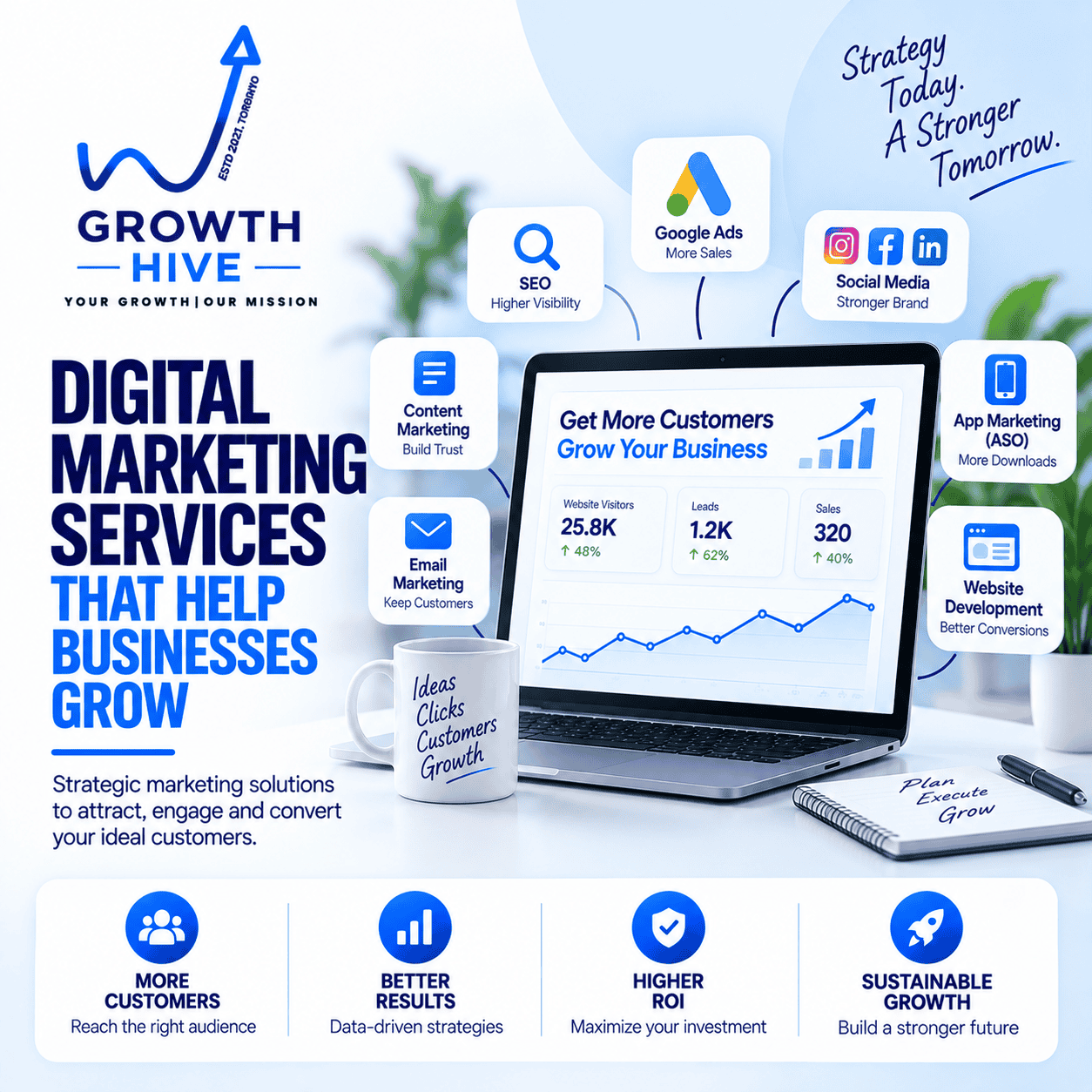
At Growth Hive, we help businesses build digital marketing strategies around their actual objectives—not around a generic list of services.
Our approach can bring together:
SEO → Google Ads → Social Media → Content → Email → Website Development → Conversion Optimization
Each channel has a purpose.
Each activity should support the customer journey.
And the strategy should ultimately support real business growth.
Because being visible online is only the beginning.
The real goal is to turn attention into opportunities, opportunities into customers, and customers into long-term business value.
Ready to make your digital marketing work harder?
If you’re getting traffic without leads, engagement without sales, or spending on marketing without clear results, talk to Growth Hive and let’s identify where your digital strategy can improve.


Leave a Reply