

Your App Can Be Great and Still Go Unnoticed
You built the app.
You invested in development.
You tested the features.
You launched it on the App Store or Google Play.
Then you waited for users.
But the downloads didn’t come as expected.
This is one of the most frustrating problems for app businesses.
Because sometimes the issue isn’t the app itself.
Your app may be excellent, but if people can’t discover it, understand its value, trust it, and choose to download it, all that development work can struggle to produce a return.
This is where App Store Optimization (ASO) becomes important.
ASO is about improving how your app is discovered and presented in app stores so you can attract more relevant users and turn app-store visitors into downloads.
But good ASO isn’t simply adding keywords to an app title.
It connects:
Visibility → Relevance → Trust → Conversion → Growth
And that’s exactly where many businesses need help.
What Is App Store Optimization?
App Store Optimization is the process of improving an app’s presence in app stores to increase its visibility, relevance and ability to convert potential users into downloads.
Depending on the app and market, ASO can involve:
- Keyword research
- Search-intent analysis
- App title optimization
- Subtitle or short-description optimization
- Long-description optimization
- Keyword optimization
- App icon strategy
- Screenshot optimization
- Preview video strategy
- Feature graphic optimization
- Ratings and reviews strategy
- Localization
- Competitor research
- Conversion rate optimization
- Performance analysis
- A/B testing
- Ongoing optimization
The exact approach depends on your app, audience, category, and business model.
An e-commerce app shouldn’t be marketed the same way as a banking app.
A fitness app shouldn’t communicate like a B2B SaaS application.
A food delivery app shouldn’t compete for the same search behavior as an educational app.
Your ASO strategy needs to reflect how your customers actually discover and evaluate apps.
The Real Business Problems ASO Can Address
Businesses rarely say:
“We need better metadata.”
They usually say:
“We’re not getting enough downloads.”
Or:
“Our competitors are getting more visibility.”
Or:
“People visit our app page but don’t install.”
Or:
“We’re spending too much on paid user acquisition.”
These are business problems.
ASO can address many of the factors behind them.
Let’s look at the most common concerns.
Problem 1: “Our App Isn’t Getting Discovered”
You can have the best app in your category and still have a visibility problem.
Think about how many apps already exist.
When someone searches for something relevant to your business, you aren’t competing against an empty marketplace.
You’re competing for attention.
Your app needs to communicate its relevance clearly.
That starts with understanding what your potential users actually search for.
For example, a fitness app might need to understand searches around:
- Workout apps
- Home workout
- Weight loss
- Running
- Strength training
- Fitness tracker
- Personal training
But simply adding all of those terms isn’t the strategy.
You need to understand:
Which searches matter to the business?
Which searches reflect genuine user intent?
Which terms fit the app?
Which searches can realistically be competed for?
That’s where proper ASO research starts.
Problem 2: Your Competitors Are Getting More Downloads
Imagine two apps solve a similar problem.
One appears prominently when users search.
The other is buried far down the results.
Even if both products are excellent, the first app has a major advantage:
It gets discovered.
Competitor research can help businesses understand:
- What keywords competitors target
- How they position their apps
- What their screenshots communicate
- How they describe their value proposition
- What users praise
- What users complain about
- Where competitors appear strong
- Where opportunities may exist
The goal isn’t to copy competitors.
It’s to find the gaps they haven’t addressed.
Sometimes your opportunity isn’t competing head-on.
It might be finding a more specific audience or search intent where your app provides a stronger solution.
Problem 3: People Find Your App but Don’t Download It
This is where conversion optimization becomes critical.
Suppose your app receives thousands of store-page visitors.
But only a small percentage install.
You don’t necessarily have a visibility problem.
You may have a conversion problem.
When users reach your app listing, they quickly form an opinion.
They look at:
- App icon
- Title
- Screenshots
- Ratings
- Reviews
- Description
- Visual presentation
- Features
- Value proposition
They are essentially asking:
“Why should I download this?”
If the answer isn’t obvious, they move on.
ASO therefore isn’t just about getting people to your listing.
It’s about giving them enough confidence to take the next step.
Your App Screenshots Are Sales Material
Many businesses treat screenshots as decoration.
That’s a mistake.
Your screenshots are part of your sales pitch.
Instead of simply showing:
Dashboard
Settings
Profile
you can communicate benefits.
For example:
Track Your Progress
Find Your Next Workout
Manage Everything in One Place
Order Faster. Delivered to Your Door.
The user shouldn’t have to study your interface to understand why your app is valuable.
Your screenshots should tell a story.
A simple structure could be:
Problem → Solution → Benefit → Feature → Action
Your screenshots aren’t just showing the product.
They’re helping sell it.
Problem 4: Your App Description Doesn’t Explain the Value
A common mistake is writing descriptions from the company’s perspective.
For example:
“Our application uses advanced technology to provide users with an innovative platform.”
Sounds impressive.
But what does the user actually get?
A stronger message might explain:
“Manage your appointments, receive reminders and keep your schedule organized from one place.”
The difference is simple.
The first talks about the company.
The second talks about the customer.
Good ASO copy answers the user’s question: “What’s in it for me?”
Problem 5: You’re Targeting the Wrong Keywords
More keywords don’t necessarily mean better ASO.
Imagine an app targets a highly competitive term with enormous search volume.
It might look impressive in a report.
But if the app has little chance of gaining meaningful visibility—or the users searching that term aren’t likely to become customers—the keyword may have limited business value.
A smarter approach considers:
- Relevance
- Search intent
- Competition
- Business value
- User expectations
- Conversion potential
You don’t need every searcher.
You need the right searchers.
Problem 6: Your App Has Downloads but Poor User Quality
Downloads are useful.
But not every download is valuable.
Imagine:
10,000 downloads
but users don’t:
- Complete onboarding
- Subscribe
- Purchase
- Book
- Use the core feature
- Return to the app
Compare that with:
3,000 highly relevant users
who become paying customers.
Which result would you prefer?
For most businesses, the answer is obvious.
That’s why ASO should be connected to the broader customer journey.
The goal isn’t simply:
More downloads.
The goal is:
More valuable users.
Problem 7: Your Ratings and Reviews Are Hurting Conversion
Before downloading an unfamiliar app, many people look at ratings and reviews.
A poor rating can create immediate hesitation.
Even a good app can accumulate negative reviews if users experience:
- Bugs
- Confusing onboarding
- Poor support
- Unexpected pricing
- Crashes
- Missing features
- Difficult cancellation
- Misleading expectations
ASO can help businesses analyze review patterns and identify recurring concerns.
Reviews are not just reputation signals.
They’re customer feedback.
If hundreds of users complain about the same issue, your marketing team shouldn’t simply try to hide the problem.
Your product team should know about it.
Sometimes the best ASO improvement isn’t a new keyword.
It’s fixing what customers dislike.
Problem 8: You’re Spending Too Much on Paid User Acquisition
Paid advertising can accelerate app growth.
But constantly paying to acquire every user can become expensive.
ASO can support a more sustainable acquisition strategy by improving organic discovery.
Think of your acquisition channels as a portfolio:
Paid acquisition
Organic discovery
Referral
Social
Content
The stronger your organic app-store presence becomes, the less dependent you may be on paid traffic for every new user.
ASO doesn’t replace paid acquisition.
It can make your overall acquisition strategy more efficient.
ASO for E-Commerce Apps
E-commerce businesses can use ASO to make their mobile shopping experience easier to discover.
For example:
- Fashion stores
- Electronics retailers
- Grocery businesses
- Beauty brands
- Furniture companies
- Online marketplaces
A potential customer might search for an app related to shopping, a product category or a specific brand.
Your listing needs to immediately communicate:
What can I buy?
Why should I use the app?
What makes the app better than the website?
You might highlight:
- Faster shopping
- Exclusive offers
- Personalized recommendations
- Easy checkout
- Order tracking
- Loyalty rewards
- Mobile-exclusive deals
The objective is to make the app feel useful, not simply like a smaller version of the website.
ASO for Local Businesses
Local businesses can benefit from apps too.
Consider:
- Restaurants
- Delivery services
- Gyms
- Salons
- Clinics
- Retail stores
- Local marketplaces
- Transportation services
An app can encourage customers to:
- Book appointments
- Order products
- Make reservations
- Receive offers
- Track orders
- Join loyalty programs
- Communicate with the business
For these businesses, ASO can be combined with local marketing and paid campaigns to reach users in specific markets.
The important thing is aligning app visibility with the locations the business can actually serve.
ASO for SaaS and B2B Apps
Not every app is designed for mass consumer downloads.
B2B applications often have a different objective.
The goal may be:
Demo requests
Free trials
Account registrations
Business subscriptions
Team adoption
For these apps, ASO messaging should communicate business value.
For example:
- Improve productivity
- Manage projects
- Automate workflows
- Track business performance
- Collaborate with teams
- Manage customers
- Reduce administrative work
The audience may be smaller, but the value of each customer can be much higher.
That changes the ASO strategy.
ASO for Fintech and Financial Apps
Financial applications operate in a trust-sensitive category.
Users may be asking:
Is this safe?
Can I trust this company?
Is my information protected?
Is this service legitimate?
Therefore, an app store presentation needs to communicate credibility alongside functionality.
Depending on the business and applicable requirements, the listing may need to make important information clear around:
- Core functionality
- Company identity
- Security
- Fees
- Supported services
- Account features
The principle is simple:
Don’t make users work to understand whether they can trust your app.
ASO for Healthcare Apps
Healthcare applications have another important consideration:
Trust.
Users may be searching for:
- Doctor booking
- Medication management
- Health tracking
- Fitness
- Telehealth
- Mental wellness
- Patient services
The app listing needs to communicate what the product actually does without making misleading claims.
Clear messaging matters.
So does an easy-to-understand user experience.
For healthcare businesses, ASO should work alongside strong product credibility and responsible communication.
ASO for Education Apps
Education apps compete in a crowded marketplace.
There are apps for:
- Languages
- Mathematics
- Exam preparation
- Professional skills
- Children’s education
- Coding
- Online courses
The user may ask:
What will I learn?
How quickly can I learn it?
Who is this for?
Why should I choose this app?
Your app listing should make those answers obvious.
International ASO: One App Doesn’t Mean One Strategy
If your app operates internationally, simply translating your English listing isn’t always enough.
Different markets can have different:
- Search behavior
- Language
- Terminology
- Cultural expectations
- Competitors
- User needs
- Purchasing behavior
For example, a phrase that sounds natural in one country may be rarely searched in another.
International ASO should therefore consider local search behavior, not just literal translation.
Localization can include:
- App title
- Subtitle
- Description
- Keywords
- Screenshots
- Promotional messaging
- Visuals
- User expectations
Your app may be global.
Your ASO strategy shouldn’t be blindly identical everywhere.
Localization Is More Than Translation
Suppose your app description is translated word-for-word.
Technically, it’s another language.
But does it sound like something a local customer would actually search for?
That’s the important question.
Good localization considers:
How does this market describe the problem?
What words do customers actually use?
What benefits matter most here?
Which competitors are already established?
Does the visual presentation make sense locally?
The goal is to make the app feel native to the market, not merely translated.
ASO and App Store Conversion Rate Optimization
Think of ASO as two connected challenges.
Challenge 1: Get Discovered
Improve relevance and visibility.
Challenge 2: Get Chosen
Improve conversion from store visitor to download.
If you solve only the first, you can have plenty of visibility but weak downloads.
If you solve only the second, you may have a beautiful app listing that hardly anyone sees.
You need both.
Visibility without conversion wastes opportunity.
Conversion without visibility limits scale.
A Strong ASO Strategy Starts With Research
Before changing your app title or description, understand the market.
Research can examine:
- Target audience
- Search behavior
- Competitors
- App category
- Keywords
- User reviews
- Common pain points
- Feature expectations
- Conversion barriers
This creates the foundation for your ASO strategy.
Without research, optimization becomes guesswork.
Your App Listing Should Tell One Clear Story
Imagine a potential user sees:
Title: Technical company name
Screenshot: Random dashboard
Description: Corporate language
Reviews: Mixed feedback
CTA: Install
They still have to figure out what your app does.
Instead, your listing should create a clear narrative:
Here’s what the app does.
↓
Here’s the problem it solves.
↓
Here’s why it is useful.
↓
Here’s how it works.
↓
Here’s why people trust it.
↓
Here’s why you should try it.
That is conversion-focused ASO.
Don’t Optimize for Downloads Alone
A successful app business should eventually look beyond installs.
Depending on the business model, you may care about:
- Activation
- Registration
- Trial starts
- Subscriptions
- Purchases
- Bookings
- Lead generation
- In-app engagement
- Retention
- Customer lifetime value
For example:
100,000 downloads
sounds impressive.
But if only 500 people become paying customers, the number doesn’t tell the full story.
ASO should ultimately support business economics.
ASO and Paid App Marketing Should Work Together
Paid campaigns can generate immediate exposure.
ASO can improve the experience users encounter when they discover your app in the store.
That creates an important relationship.
Imagine a user clicks an advertisement.
They reach your app store listing.
Now they see:
- Strong screenshots
- Clear benefits
- Relevant messaging
- Positive reviews
- Professional branding
The paid campaign brought the user there.
ASO helps give them a reason to install.
This is why paid acquisition and ASO shouldn’t operate in separate worlds.
Common ASO Mistakes Businesses Should Avoid
Stuffing Keywords Everywhere
Using a keyword repeatedly doesn’t automatically improve relevance.
Write naturally and accurately.
Using Generic Screenshots
Your screenshots should communicate benefits, not simply display random screens.
Copying Competitors
Competitor research is valuable.
Copying their positioning isn’t a strategy.
Ignoring Reviews
Reviews provide direct insight into what customers love and hate.
Use that information.
Focusing Only on Downloads
Downloads are an acquisition metric.
Revenue and retention determine business value.
Forgetting Localization
International users don’t necessarily search the same way.
Optimizing Once and Forgetting About It
Search behavior, competitors, products, and customer expectations change.
ASO should be iterative.
What Does a Professional ASO Service Include?
A comprehensive ASO service can include:
ASO Audit
Identify current visibility and conversion opportunities.
Keyword Research
Find relevant search terms based on intent and competition.
Competitor Analysis
Understand how competing apps position themselves.
Metadata Optimization
Improve titles, subtitles, descriptions and relevant keyword fields.
Creative Optimization
Improve icons, screenshots, videos and other visual assets.
Conversion Optimization
Make the app listing more persuasive.
Review Analysis
Identify recurring customer concerns and opportunities.
Localization
Adapt listings for relevant international markets.
Testing
Compare variations and learn what performs better.
Reporting
Track visibility, conversion and business outcomes.
Ongoing Optimization
Continue improving as the market changes.
That’s the difference between:
“We uploaded some keywords.”
and:
“We have an ASO strategy.”
How to Measure ASO Performance
ASO reporting should connect app-store activity to business outcomes.
Important metrics can include:
Keyword Visibility
Are you appearing for strategically valuable searches?
Impressions
How often is your listing being shown?
Store Page Views
Are people reaching your app listing?
Conversion Rate
How many visitors install?
Organic Downloads
How many users discover the app without directly relying on paid acquisition?
Cost Per Acquisition
How much does it cost to acquire users through your broader marketing strategy?
Activation
How many users actually start using the app?
Retention
Do users continue using it?
Revenue
Is the app producing meaningful commercial value?
The best KPI depends on your business model.
But the principle remains:
Measure ASO against business objectives, not vanity numbers.
A Practical ASO Framework for Businesses
A strong ASO program can follow this process:
1. Understand the Business
What does the app actually need to achieve?
2. Understand the User
Who is downloading it and what problem are they trying to solve?
3. Research Search Behavior
What are users searching for?
4. Analyze Competitors
Where are competitors winning—and where are they weak?
5. Optimize the Listing
Improve messaging, metadata and creative assets.
6. Improve Conversion
Make the value proposition immediately clear.
7. Test
Experiment with meaningful variations.
8. Measure
Track visibility, installs and downstream business results.
9. Refine
Use data and customer feedback to improve continuously.
ASO isn’t a one-time task.
It’s an optimization cycle.
Your App Is a Business Asset
It’s easy to think of an app as a technology product.
But for most companies, it’s much more than that.
Your app can become:
- A sales channel
- A customer service channel
- A booking platform
- A communication channel
- A loyalty tool
- A subscription product
- A marketplace
- A recurring revenue engine
That means the way people discover and evaluate your app matters.
If your app is difficult to find, you lose potential users.
If your listing doesn’t communicate value, you lose downloads.
If your onboarding is poor, you lose activation.
If your product doesn’t deliver value, you lose retention.
ASO solves the first part of that journey—but the entire experience needs to work together.
ASO Is About More Than Rankings
Ranking higher feels good.
But rankings aren’t the final destination.
Imagine your app moves from position 50 to position 10.
Great.
But if the wrong people are discovering it, or the listing isn’t convincing them to download, the business impact may still be limited.
The better objective is
Reach the right people → convince them → acquire them → retain them → create customer value.
That’s what makes ASO commercially meaningful.
Turn App Visibility Into Real Business Growth
You may have invested heavily in building your app.
Don’t let discovery become the weak point.
Your potential customers are already searching for solutions.
They’re comparing apps.
They’re reading reviews.
They’re looking at screenshots.
They’re deciding which app deserves space on their phone.
The question is:
Will your app be visible and will your listing give them a reason to choose it?
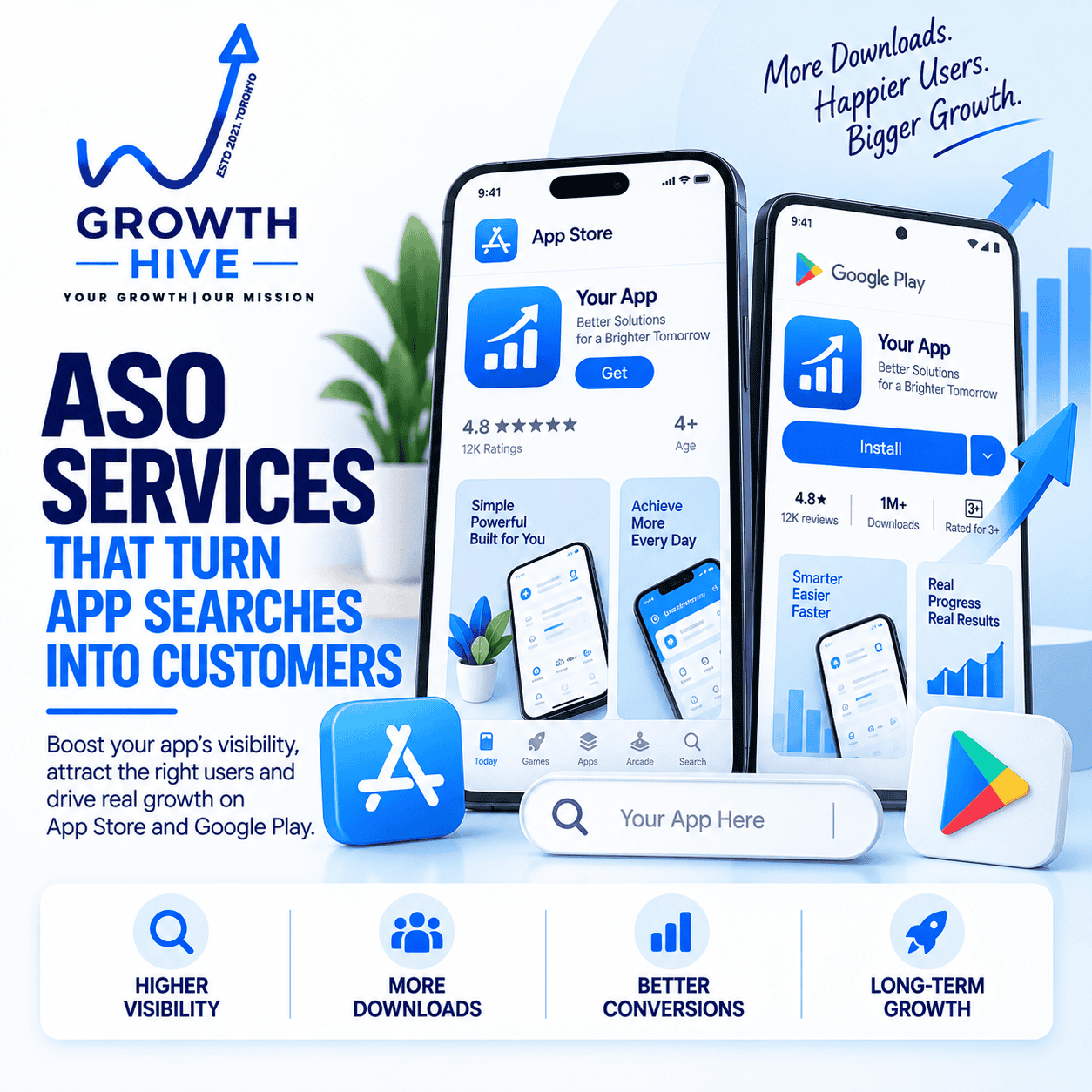
At Growth Hive, we help businesses approach ASO as a complete growth strategy rather than a simple keyword exercise.
Whether you’re building an e-commerce app, SaaS product, B2B platform, fintech application, healthcare app, education product, local service app, marketplace, or consumer application, your ASO strategy should reflect your audience, market, and commercial goals.
We can help businesses address the full journey:
Research → Visibility → Listing Optimization → Conversion → Testing → Measurement → Growth
Because more downloads are useful.
But more of the right users are what can actually move your business forward.
Ready to get more from your app?
If your app isn’t getting the visibility, downloads, or user quality you expected, talk to Growth Hive and identify the ASO opportunities that can turn app-store searches into meaningful business results.


Leave a Reply