

Your App Can Be Excellent and Still Go Unnoticed
You invested in developing an app.
Your developers built the features.
Your designers worked on the interface.
Your team tested the experience.
You launched it on the App Store or Google Play.
Then you waited for users.
But the downloads didn’t come as expected.
Maybe your app is genuinely useful. Maybe customers who use it love it. Maybe you’ve spent heavily on development and advertising.
Yet people still aren’t discovering it.
This is a frustrating situation because building a great app and getting people to find it are two different challenges.
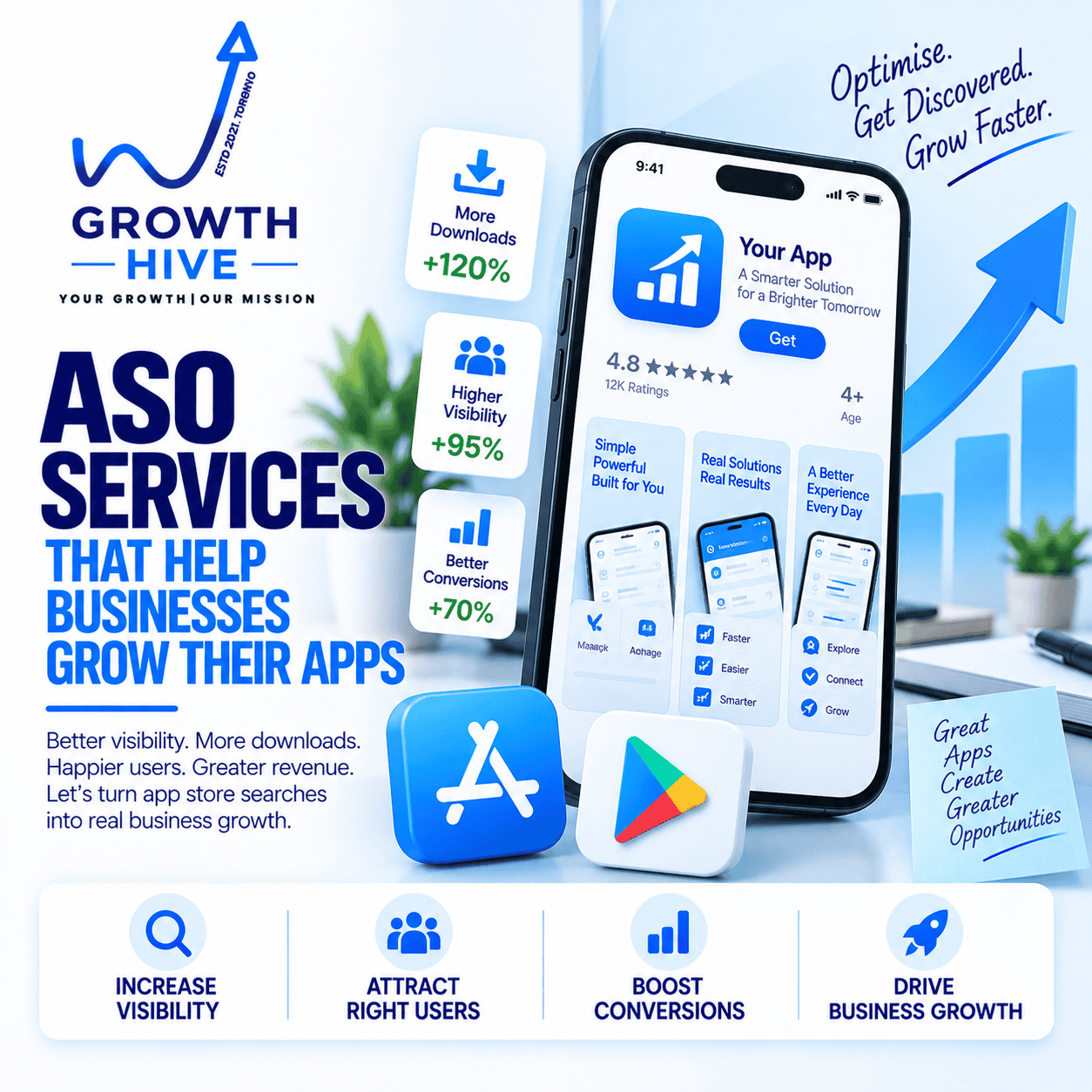
That’s where App Store Optimization (ASO) comes in.
ASO helps businesses improve how their apps are presented and discovered in app stores, with the broader goal of attracting relevant users and converting store visitors into downloads.
But effective ASO isn’t simply about adding keywords.
It’s about understanding your customers, your competitors, your market and the reason someone would choose your app over the alternatives.
What Is App Store Optimization?
App Store Optimization is the process of improving an app’s store presence to increase its visibility, relevance and conversion potential.
Depending on the business and app, ASO can involve:
- Keyword research
- Search-intent analysis
- Competitor research
- App title optimization
- Subtitle optimization
- Short and long description optimization
- Keyword-field optimization
- App icon strategy
- Screenshot optimization
- Preview video strategy
- Ratings and review analysis
- Localization
- Conversion optimization
- A/B testing
- Performance monitoring
The exact strategy depends on the business.
A food delivery app shouldn’t be marketed like a B2B SaaS application.
A healthcare app shouldn’t communicate like a fashion marketplace.
A banking application has very different trust requirements from a gaming app.
Good ASO starts with the business and the customer—not with a generic keyword list.
Why Businesses Struggle With App Growth
Most businesses don’t come to ASO saying:
“Our metadata needs optimization.”
They say:
“We’re not getting enough downloads.”
Or:
“Our competitors are getting more visibility.”
Or:
“People visit our app page but don’t install.”
Or:
“We’re spending too much on paid acquisition.”
Or:
“We have thousands of downloads, but very few customers.”
Each problem points toward a different part of the app-growth journey.
Let’s break them down.
Problem 1: Your App Isn’t Getting Discovered
Imagine someone searches for a solution your app provides.
Your competitors appear.
Your app doesn’t.
It doesn’t matter how good your application is if the potential customer never sees it.
This is why keyword and search-intent research matters.
A business should understand:
- What do potential users search for?
- How do they describe their problem?
- What solutions are they looking for?
- Which searches have commercial value?
- Which terms are relevant to the app?
- What are competitors already targeting?
The objective isn’t to rank for every possible keyword.
It’s to become visible for searches that matter to your business.
Problem 2: Your Competitors Are Getting More Visibility
Your app may be competing against dozens, hundreds or thousands of alternatives.
Users have choices.
A competitor may have:
- Better app-store positioning
- Stronger screenshots
- More reviews
- Better messaging
- Higher visibility
- Stronger brand recognition
- A clearer value proposition
Instead of simply asking:
“How do we beat them?”
look at what they’re doing.
Study:
- Their titles
- Descriptions
- Keywords
- Screenshots
- Visual hierarchy
- Ratings
- Reviews
- Feature positioning
- Customer complaints
Then look for gaps.
Perhaps competitors focus heavily on features while your business can communicate a stronger benefit.
Perhaps they target a broad audience while your app solves a specific problem exceptionally well.
The opportunity often comes from being more relevant, not simply being louder.
Problem 3: People Find Your App but Don’t Download It
This is an important distinction.
Suppose your app-store listing receives thousands of visitors.
But only a small percentage install the app.
You may not have a visibility problem.
You may have a conversion problem.
When someone reaches your listing, they quickly ask:
What does this app do?
How will it help me?
Can I trust it?
Is it worth installing?
Your:
- Icon
- Title
- Screenshots
- Description
- Ratings
- Reviews
- Video
- Visual presentation
all contribute to that decision.
ASO therefore has two connected jobs:
Get discovered.
Get chosen.
You need both.
Your Screenshots Are Part of Your Sales Pitch
Many businesses treat app screenshots as simple product images.
But screenshots can do much more.
Instead of showing:
Dashboard
Profile
Settings
you can communicate benefits such as:
Manage Everything in One Place
Book in Seconds
Track Every Order
Save Your Favorite Products
Stay on Top of Your Business
The customer shouldn’t have to study the interface to understand the value.
Your screenshots should tell a story.
For example:
Problem → Solution → Benefit → Feature → Action
That’s much more persuasive than simply showing a collection of screens.
Problem 4: Your App Description Talks About You Instead of the Customer
Consider this:
“Our innovative platform uses advanced technology to provide users with a seamless digital experience.”
It sounds professional.
But what does the customer actually get?
Now compare it with:
“Book appointments, manage your schedule and receive reminders from one place.”
The second message is much easier to understand.
Good ASO copy should answer:
What’s in it for me?
Talk about:
- The customer’s problem
- The desired outcome
- The key benefit
- Important features
- Why the app is useful
- Why the user should take action
Don’t make customers work to understand your product.
Problem 5: You’re Targeting the Wrong Keywords
A keyword can have enormous search volume and still provide limited business value.
Imagine your app targets a highly popular term.
Thousands of people search for it.
But most of those people aren’t potential customers.
What have you gained?
Potentially a lot of visibility—but not necessarily the right users.
Keyword research should consider:
- Relevance
- Search intent
- Competition
- User expectations
- Commercial value
- Conversion potential
A smaller group of highly relevant users can be more valuable than a huge audience that has no reason to use your app.
The objective isn’t maximum traffic.
It’s meaningful discovery.
Problem 6: You Have Downloads but Not Valuable Users
This is where businesses need to look beyond download numbers.
Imagine:
50,000 downloads
but users don’t:
- Complete registration
- Use the core feature
- Subscribe
- Purchase
- Book
- Return to the app
The download number looks impressive.
The business result may not.
Now imagine:
10,000 downloads
with a much higher percentage of users becoming paying customers.
That’s a very different outcome.
Depending on the business model, ASO should ultimately support metrics such as:
- Activation
- Engagement
- Purchases
- Subscriptions
- Bookings
- Leads
- Retention
- Customer lifetime value
A download is the beginning of the customer journey, not the end.
ASO for E-Commerce Businesses
E-commerce businesses can use ASO to make their shopping apps easier to discover and more compelling to install.
This includes:
- Fashion brands
- Electronics retailers
- Grocery businesses
- Beauty brands
- Furniture stores
- Marketplaces
- Specialty retailers
The app listing should quickly communicate:
What can I buy?
Why should I use the app?
What makes the app better or more convenient?
Potential benefits might include:
- Faster checkout
- Personalized recommendations
- Order tracking
- Loyalty rewards
- Exclusive offers
- Easier reordering
- Saved products
The app needs to give customers a reason to return.
ASO for Local Businesses
ASO isn’t only for global technology companies.
Local businesses can also benefit from applications.
Consider:
- Restaurants
- Gyms
- Salons
- Clinics
- Retail stores
- Delivery businesses
- Education providers
- Local marketplaces
An app could allow customers to:
- Book appointments
- Order products
- Make reservations
- Track deliveries
- Earn loyalty points
- Receive relevant offers
- Manage memberships
For these businesses, the app can become an extension of the customer relationship.
Instead of:
“Come back whenever you remember us.”
the business can create a convenient digital experience that gives customers a reason to return.
ASO for B2B Apps
B2B applications have different objectives.
The goal might be:
- Free trial registrations
- Demo requests
- Business subscriptions
- Team adoption
- Lead generation
- Productivity
Potential users may search for solutions related to:
- Project management
- CRM
- Accounting
- Productivity
- Collaboration
- Inventory
- Business operations
- Workflow automation
Your app listing needs to communicate the business outcome.
For example:
Reduce manual work.
Manage your team.
Track customers.
Automate repetitive tasks.
The message should connect the application to a real business problem.
ASO for SaaS Businesses
For SaaS companies, app-store visibility can become another customer acquisition channel.
But the customer isn’t necessarily looking for “an app.”
They’re looking for a solution.
They may be searching for:
How can I manage my projects?
How can I track my expenses?
How can I communicate with my team?
How can I automate this process?
Your ASO strategy should understand that intent.
The best listing isn’t necessarily the one with the most features.
It’s the one that makes the value of the product easy to understand.
ASO for Healthcare Apps
Healthcare applications operate in a trust-sensitive environment.
Users may be looking for:
- Appointment booking
- Telehealth
- Health tracking
- Patient services
- Wellness
- Medication-related tools
The app listing needs to communicate its purpose clearly and responsibly.
Users may ask:
Who is behind this app?
What does it actually do?
Can I trust it?
Is my information handled responsibly?
For healthcare businesses, ASO should therefore work alongside a credible product experience, transparent communication and appropriate privacy and security practices.
ASO for Education Apps
Education apps compete in a crowded market.
Students and parents may be looking for:
- Language learning
- Exam preparation
- Coding
- Mathematics
- Professional training
- Children’s education
- Online courses
The app listing needs to answer:
What will I learn?
Who is this for?
How does it work?
Why is this useful?
Screenshots can be particularly effective here because they can show the actual learning experience.
ASO for Fintech Apps
Financial applications have another major consideration:
Trust.
Users may be concerned about:
- Security
- Fees
- Account functionality
- Company credibility
- Supported services
The app listing should clearly explain what the application does without creating unrealistic expectations.
The goal is to reduce uncertainty.
Because when people are dealing with their money, uncertainty can become a major barrier to installation.
International ASO Requires Local Thinking
If your business operates internationally, one app doesn’t necessarily mean one ASO strategy.
Different markets can have different:
- Languages
- Search behavior
- Terminology
- Competitors
- Customer expectations
- Cultural preferences
- Purchasing behavior
A direct translation of your English listing may be grammatically correct but still sound unnatural to local users.
International ASO should consider how people actually search and communicate in each market.
Localization Is More Than Translation
Imagine translating your app description word-for-word into another language.
The grammar may be correct.
But does it use the terms local customers actually search for?
Does the message communicate the same benefit?
Do the screenshots feel appropriate?
Does the positioning make sense in that market?
Good localization considers:
Language + Search Behavior + Culture + Customer Intent
The goal is to make the app feel like it was built for the market—not simply translated for it.
Ratings and Reviews Can Influence the Decision
Before installing an unfamiliar app, users often look at ratings and reviews.
A strong rating can create confidence.
Negative reviews can create hesitation.
But reviews are also valuable for another reason.
They tell you what customers actually think.
Look for repeated comments about:
- Bugs
- Performance
- Pricing
- Customer support
- Missing features
- Difficult onboarding
- Confusing navigation
- Unexpected behavior
If hundreds of users complain about the same problem, changing the app-store description won’t solve the underlying issue.
Sometimes the best ASO improvement is
Fix the product.
Then let your improved customer experience strengthen your reviews over time.
ASO and Paid App Advertising Should Work Together
Paid advertising can help generate immediate app-store traffic.
But what happens when the user arrives?
They see your listing.
That means your paid campaign and ASO experience are connected.
A user might click an advertisement and then evaluate:
- App icon
- Screenshots
- Reviews
- Description
- Rating
- Value proposition
If the advertising is strong but the store listing is weak, the customer acquisition journey can break at the app-store stage.
Paid advertising creates the opportunity.
ASO helps convert that opportunity.
ASO and Your Website Should Work Together
Your app shouldn’t exist in isolation.
A potential user may discover your business through:
Google Search
↓
Website
↓
App Store
↓
Download
↓
App
Likewise, someone might discover your app first and then visit your website to learn more about the company.
Your messaging should therefore be consistent.
Your website, app listing and advertising should communicate the same core value proposition.
Don’t Forget the App Experience After Installation
ASO can help someone choose your app.
But what happens after they install it?
This is where product experience takes over.
A customer may immediately encounter:
- Complicated registration
- Too many permissions
- Long onboarding
- Confusing navigation
- Slow loading
- Unexpected subscription prompts
They may uninstall before experiencing your core value.
That’s why ASO and product experience need to work together.
Your app-store promise must match the actual app experience.
If your listing says:
“Book an appointment in seconds”
the user shouldn’t need ten steps to book.
The Emotional Side of ASO
ASO can sound technical.
Keywords.
Metadata.
Search visibility.
Conversion rate.
But behind every download is a person.
Someone who may be:
Frustrated.
Curious.
In a hurry.
Looking for help.
Trying to save money.
Trying to save time.
Trying to solve a problem.
Your app listing should acknowledge that human need.
Instead of only saying:
“Advanced appointment management platform.”
say:
“Book your appointment without the phone calls and waiting.”
The second message speaks to a feeling.
Relief.
That’s powerful.
Good ASO doesn’t just describe functionality.
It communicates the experience the user hopes to have.
Your App Icon Matters
The app icon is often one of the first visual elements users notice.
It needs to be:
- Recognizable
- Relevant
- Consistent with the brand
- Visually clear
- Distinctive within the category
An icon doesn’t have to explain everything.
It needs to create recognition and contribute to a professional first impression.
A/B Testing Can Improve App Store Conversion
You don’t have to assume your first creative direction is the best one.
Testing can help businesses learn.
Depending on the platform and available features, you can test elements such as:
- Screenshots
- Visual messaging
- App-store creative
- Descriptions
- Positioning
- Promotional approaches
For example, one screenshot might emphasize:
“Save Time”
while another emphasizes:
“Manage Everything Easily.”
The objective is to understand which message resonates more strongly with the intended audience.
ASO should be based on learning, not guessing.
What Should You Measure?
A professional ASO strategy should go beyond keyword rankings.
Useful metrics can include:
Impressions
How often is your listing being shown?
Store Page Views
How many people are evaluating your app?
Conversion Rate
How many visitors install?
Organic Downloads
How many users discover your app without direct paid acquisition?
Keyword Visibility
Are you becoming visible for valuable searches?
Activation
Do users actually start using the app?
Retention
Do they come back?
Revenue
Does the app generate commercial value?
Customer Lifetime Value
How valuable are acquired users over time?
The exact KPI depends on the business model.
But the principle is simple:
Measure ASO against business outcomes.
Common ASO Mistakes Businesses Should Avoid
Keyword Stuffing
Adding keywords everywhere can make your copy unnatural and doesn’t replace genuine relevance.
Generic Screenshots
Screenshots should communicate benefits, not simply show random interface screens.
Copying Competitors
Competitor research is useful.
Copying their strategy doesn’t create differentiation.
Ignoring Reviews
Customer reviews contain valuable product insights.
Focusing Only on Downloads
Downloads are an acquisition metric—not the complete business result.
Ignoring Localization
Different markets search differently.
Optimizing Once and Forgetting About It
Your market, competitors, users, and product will change.
ASO needs ongoing attention.
Making Promises the App Doesn’t Deliver
If the listing promises an experience the product doesn’t provide, you create disappointment.
Your marketing should match reality.
What Should a Professional ASO Service Include?
A complete ASO service can include:
ASO Audit
Understand the current strengths and weaknesses of your app-store presence.
Keyword Research
Identify relevant searches and commercial opportunities.
Competitor Analysis
Understand how competing apps position themselves.
Metadata Optimization
Improve titles, subtitles, descriptions and relevant keyword fields.
Creative Strategy
Improve icons, screenshots, videos and visual messaging.
Conversion Optimization
Make the listing easier to understand and more persuasive.
Review Analysis
Identify recurring customer concerns and opportunities.
Localization
Adapt the listing for relevant markets.
Testing
Compare meaningful variations.
Analytics
Track visibility, downloads and downstream results.
Continuous Optimization
Keep improving as the market changes.
This is the difference between:
“We added some keywords.”
and:
“We built an ASO strategy.”
A Practical ASO Strategy for Any Business
A business-focused ASO process can follow a simple framework.
1. Understand the Business
What does success actually mean?
Downloads?
Subscriptions?
Sales?
Bookings?
Leads?
2. Understand the Customer
Who is the ideal user?
What problem are they trying to solve?
3. Research Search Behavior
How do they describe that problem?
What do they search for?
4. Analyze Competitors
What are competing apps doing well?
Where are the gaps?
5. Optimize the Store Listing
Improve messaging, metadata and creative assets.
6. Improve Conversion
Make the app’s value immediately understandable.
7. Measure
Track what happens after people discover the app.
8. Learn and Improve
Use data, reviews and customer feedback to make better decisions.
ASO isn’t a one-time checkbox.
It’s an ongoing growth process.
Your App Is More Than a Download
It’s easy to celebrate when the download counter increases.
But behind every download is a potential customer.
Someone who might:
- Make a purchase
- Book a service
- Subscribe
- Place an order
- Become a repeat customer
- Recommend your business
That is why ASO should be connected to the entire customer journey.
Discovery → Download → Activation → Engagement → Conversion → Retention
If the journey breaks after installation, the acquisition strategy isn’t complete.
ASO Should Be Part of Your Digital Marketing Strategy
Your app can work alongside:
- SEO
- Google Ads
- Social Media Marketing
- Email Marketing
- Content Marketing
- Website Development
- Remarketing
For example:
SEO discovers your business.
Paid advertising creates additional reach.
Social media builds familiarity.
ASO helps users discover and choose your app.
Email keeps customers connected.
The app creates an ongoing customer experience.
That’s how individual channels become a connected marketing system.
Turn App Store Searches Into Business Opportunities
Your app may already solve a real problem.
The challenge may be getting the right people to discover it—and giving them enough confidence to choose it.
That’s where ASO becomes valuable.
It’s not just about ranking.
It’s not just about keywords.
It’s not just about downloads.
It’s about understanding the customer behind the search.
What are they trying to accomplish?
What are they worried about?
What would make their life easier?
Why should they trust your app?
And what happens after they install it?
At Growth Hive, we help businesses build ASO strategies around those questions.
Whether you’re running an e-commerce app, SaaS product, B2B platform, fintech application, healthcare app, education platform, marketplace, local service app, or consumer application, your ASO strategy should be aligned with your audience and business objectives.
Our approach can connect:
Research → Visibility → Store Optimization → Conversion → Testing → Measurement → Growth
Because getting more downloads is useful.
But getting the right users who stay, engage, and become customers is where app growth becomes meaningful.
Ready to improve your app’s visibility?
If your app isn’t getting the visibility, downloads, or user quality you expected, talk to Growth Hive and identify the opportunities that can turn app-store searches into real business growth.


Leave a Reply